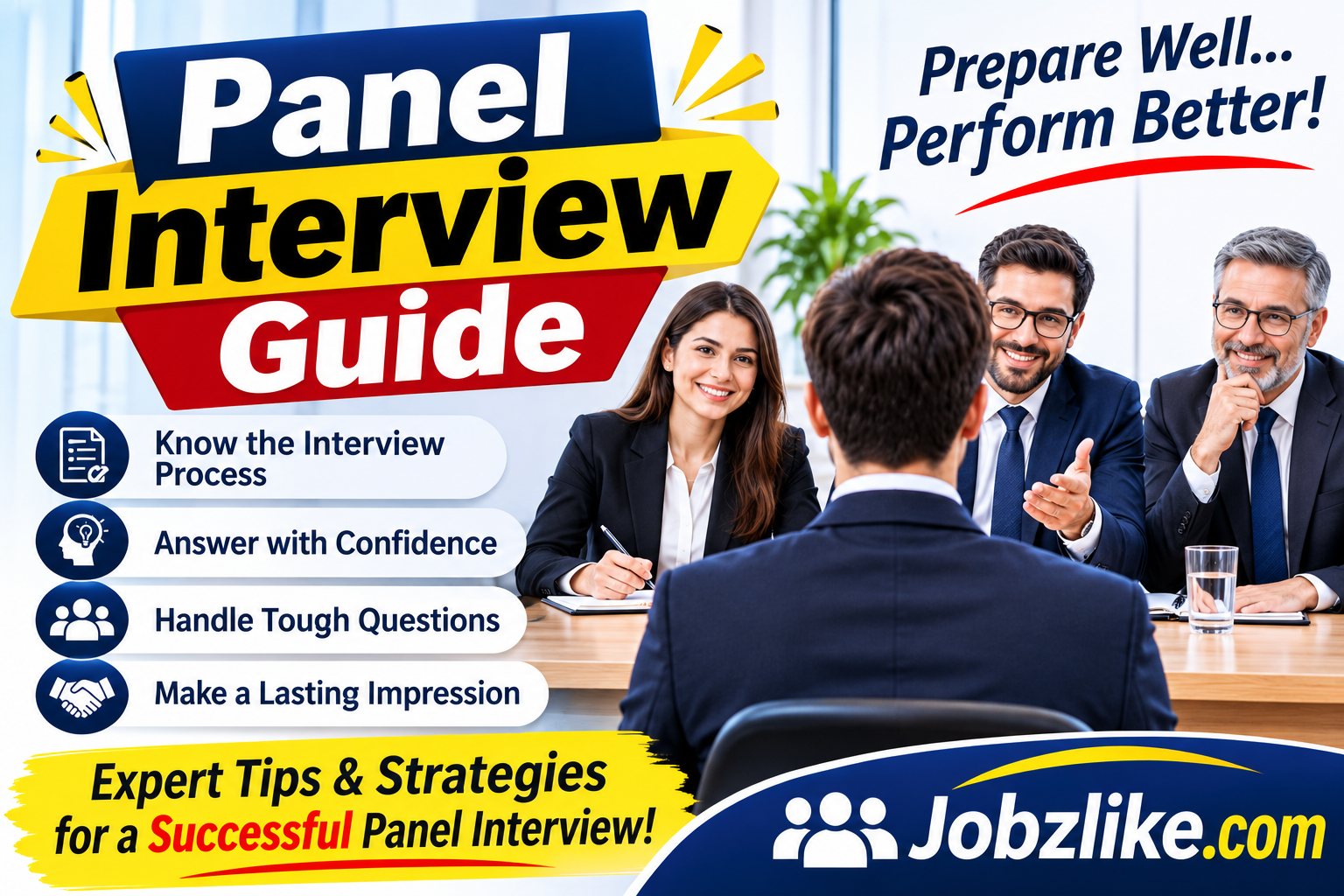
A panel interview brings several interviewers into one conversation, often representing different departments, levels of seniority, or areas of expertise. Instead of responding to one person, you may need to answer a hiring manager, a technical specialist, a human resources representative, and a future colleague in the same meeting. This format can feel demanding because questions may arrive quickly, viewpoints can differ, and each interviewer may evaluate a different part of your suitability. The good news is that difficult questions in a panel interview are manageable when you prepare a clear approach rather than memorising perfect answers.
Employers are usually interested in how you think, communicate, solve problems, and respond under pressure, not whether you can answer every question instantly. A thoughtful pause, a relevant example, and an honest explanation can make a stronger impression than a rushed response. This guide explains how to understand challenging questions, handle disagreements, discuss weaknesses, respond to unexpected scenarios, and keep your answers organised. Whether you are applying for your first position or moving into a senior role, these practical techniques can help you stay composed and show the entire panel what you can contribute.
Understand What the Interview Panel Is Really Assessing
A difficult question is not always intended to catch you out. Each panel member may be checking a different requirement, so first identify the skill or concern behind the wording.
- Questions about missed deadlines may assess accountability and planning.
- Questions about conflict may reveal communication and teamwork skills.
- Technical challenges may test your knowledge and problem-solving process.
- Questions about career changes may explore motivation and commitment.
- Situational questions may show how you make decisions with limited information.
Focus on the purpose of the question before choosing your response. This helps you answer the concern instead of getting distracted by its difficult wording.
Use a Calm Pause Instead of Rushing Into an Answer
When several people are watching, silence can feel uncomfortable. However, a short pause gives you time to understand the question and organise your thoughts. Take a breath, maintain a natural expression, and begin when you are ready. You can say, “That is an important situation; let me think through the best example.” Avoid filling every second with unnecessary words. A measured response communicates confidence and care.
- Listen until the interviewer finishes speaking.
- Take two or three seconds to organise your thoughts.
- Ask for clarification if the question has more than one part.
- Start with your main point before adding supporting detail.
- Keep your voice steady and your pace conversational.
Build Strong Answers With the STAR Interview Method
The STAR method is useful when a panel asks for evidence from your previous experience. It keeps your answer focused and helps interviewers understand your contribution.
- Situation: Briefly explain the background and the challenge.
- Task: Describe the responsibility or outcome you needed to achieve.
- Action: Explain the steps you personally took.
- Result: Share the outcome and what you learned.
Spend most of your time explaining the action and result. If you use “we” to describe a team achievement, clarify what you specifically handled. Where possible, include a measurable result, such as reduced processing time, improved customer satisfaction, or completion before a deadline.
Common Difficult Panel Interview Questions and Their Purpose
| Question | What the panel may assess | Answer direction |
|---|---|---|
| What is your biggest weakness? | Self-awareness and improvement | Name a genuine manageable area and explain your improvement plan. |
| Tell us about a failure. | Accountability and learning | Describe your role, corrective action, and lesson. |
| Why should we hire you? | Role fit and confidence | Connect two or three strengths to the job requirements. |
| How do you handle disagreement? | Professional communication | Show how you listen, assess evidence, and agree on next steps. |
| Why are you leaving your current job? | Motivation and judgement | Keep the explanation truthful, respectful, and future-focused. |
Respond Professionally When You Do Not Know the Answer
You do not need to pretend to know everything. Guessing confidently can damage credibility, particularly when a technical interviewer understands the subject well. Acknowledge the limit of your knowledge, explain what you do know, and describe how you would find a reliable answer.
- Be direct: “I have not worked with that specific system yet.”
- Connect to related knowledge or experience when relevant.
- Explain the steps you would take to investigate the issue.
- Show willingness to learn without making unrealistic promises.
- Never invent qualifications, figures, or project experience.
Honesty combined with a sensible problem-solving approach can demonstrate professional maturity.
Handle Multiple Questions Without Losing Your Main Point
Panel members sometimes ask a question that contains several requests. If you answer only the first part, the panel may not receive the evidence it needs. Listen for separate tasks and address them in a clear order.
- Mentally divide the question into its individual parts.
- Repeat or summarise the key points if that helps confirm your understanding.
- Answer the most important point first.
- Use short transitions such as “There are two parts to that.”
- Check that you have addressed every part before finishing.
How to Discuss Weaknesses, Mistakes, and Career Gaps
| Challenging topic | Unhelpful response | Stronger approach |
|---|---|---|
| Weakness | “I have no weaknesses.” | Identify a real development area and the steps you are taking. |
| Work mistake | Blaming a colleague or hiding your role. | Accept responsibility and explain how you corrected the issue. |
| Career gap | Giving a defensive or unnecessarily personal explanation. | Offer a concise, truthful explanation and highlight current readiness. |
| Short job tenure | Criticising the previous employer. | Explain the circumstances neutrally and what you seek next. |
Keep sensitive personal details private unless you choose to share them. The panel needs a relevant and honest explanation, not every detail of your life.
Stay Composed When Interviewers Challenge Your Opinion
An interviewer may disagree with your recommendation or ask you to defend a decision. Treat this as an opportunity to explain your reasoning, not as a personal argument. Listen carefully, recognise any valid point, and support your position with evidence. If new information changes your view, say so. Being adaptable is not the same as lacking confidence.
Comparing Weak and Effective Responses to Tough Questions
| Interview situation | Weak response | Effective response |
|---|---|---|
| Conflict with a manager | “My manager was always wrong.” | Explain the difference in views, respectful discussion, and agreed outcome. |
| High workload | “I just work harder than everyone.” | Describe how you prioritise, communicate capacity, and track deadlines. |
| Failure | “It was not my fault.” | Own your part, explain the recovery, and state what changed afterward. |
| Unknown technical topic | Making up an answer. | State your current knowledge and outline a method to verify the answer. |
Manage Different Personalities Across the Interview Panel
One interviewer may be friendly, another formal, and another may ask rapid technical questions. Do not assume that a serious expression means disapproval. Maintain the same respectful and professional manner with everyone.
- Share your attention across the panel rather than speaking only to the chairperson.
- Begin by looking at the person who asked the question.
- Include other panel members naturally as you explain your answer.
- Do not interrupt or compete for attention.
- Keep your tone courteous even if a question feels abrupt.
Prepare Examples That Prove Your Skills
General claims such as “I am hardworking” are less convincing than examples. Before the interview, prepare a small collection of experiences that can answer different types of questions.
- A project where you solved a difficult problem.
- A time you worked with someone whose approach differed from yours.
- An example of learning a new tool or process quickly.
- A mistake that led to a better working method.
- A situation where you managed competing deadlines.
- An achievement that connects directly to the advertised role.
Choose examples that are accurate and recent where possible. Adapt the detail to the question rather than repeating the same long story every time.
Use Evidence and Numbers Without Exaggerating
| Instead of saying | Make the evidence clearer |
|---|---|
| “I improved the process.” | Explain what changed and the verified time or quality improvement. |
| “I helped customers.” | Describe the type of issue resolved and the feedback or outcome received. |
| “I managed a team project.” | State your responsibility, team size if relevant, and delivery result. |
| “I am good at meeting deadlines.” | Give an example of how you planned and completed a time-sensitive task. |
Use only figures you can explain if the panel asks a follow-up question. If you do not know an exact percentage, describe the improvement accurately without inventing a number.
What to Do When a Question Feels Unfair or Too Personal
Some questions may seem unrelated to the role or may touch on private matters. Stay composed and consider whether the interviewer is asking about a legitimate job requirement. You can politely redirect the discussion toward your ability to perform the work. For example, you might say, “I can meet the role’s stated schedule and responsibilities. Is there a particular work requirement you would like me to address?” Avoid responding aggressively. If a question raises a serious concern, make a note of it and consider whether the organisation is the right workplace for you.
Practical Phrases That Help You Regain Control
- “Could you clarify which part of the situation you would like me to focus on?”
- “I would approach that by first identifying the cause.”
- “A relevant example from my previous role is…”
- “I understand that concern. The evidence I considered was…”
- “I have not encountered that exact case, but I would take these steps…”
- “That is a fair point, and I would also consider…”
- “May I take a moment to organise my thoughts?”
Use these phrases naturally. They are tools for clear communication, not scripts that should be repeated mechanically.
Common Mistakes That Can Weaken Your Panel Interview Performance
- Interrupting a question before the interviewer has finished.
- Giving long answers that hide the main point.
- Speaking negatively about former managers or colleagues.
- Claiming skills or achievements that you cannot support.
- Directing every answer toward only one panel member.
- Becoming defensive when someone asks a follow-up question.
- Using memorised responses that do not address the question.
- Forgetting to explain your own contribution to a team result.
Review these habits during practice. Small improvements in listening, structure, and tone can make your answers more persuasive.
Adapt Your Answers to the Role and Industry
The best response depends on the job. A customer service panel may focus on patience and conflict resolution, while an engineering panel may explore safety, accuracy, and technical judgement. Research the job description and identify the most important capabilities. Then select examples that demonstrate those capabilities. For a leadership role, prepare stories about coaching, delegation, and difficult decisions. For an entry-level position, use academic projects, volunteering, internships, or other genuine experiences when you have limited employment history.
Questions You Can Ask the Panel at the End
| Question to ask | What it helps you understand |
|---|---|
| What would success look like in the first three months? | Priorities and performance expectations. |
| How does this team handle challenging projects? | Collaboration and problem-solving culture. |
| What training or development is available? | Learning opportunities and support. |
| What are the next steps in the selection process? | Timeline and follow-up expectations. |
Choose questions that have not already been answered. Asking thoughtful questions shows that you are evaluating the role seriously as well as trying to make a positive impression.
A Simple Preparation Routine for the Day Before
- Read the job description and note its key requirements.
- Research the organisation, its services, and recent public developments.
- Practise answers to common difficult questions aloud.
- Prepare four or five STAR examples from your real experience.
- Review your CV so dates, responsibilities, and achievements are clear.
- Plan your route, arrival time, clothing, and any documents required.
- Get enough rest rather than trying to memorise answers all night.
How to Recover if You Give an Unclear Answer
Not every answer will come out perfectly. If you notice that you have missed the point, correct yourself politely instead of allowing confusion to continue. You can say, “Let me clarify the main point,” and then provide a shorter, more direct response. If you misunderstood the question, ask whether the interviewer would like you to address a different aspect. A calm correction demonstrates awareness and communication skills. Do not apologise repeatedly or turn one imperfect answer into the focus of the whole interview. Move forward and give your full attention to the next question.
Conclusion: Turn Difficult Panel Questions Into an Opportunity
Learning how to handle difficult questions in a panel interview is mainly about preparation, composure, honesty, and clear communication. You cannot predict every question or control the personalities in the room, but you can control how you listen, organise your thoughts, and support your answers with relevant evidence. Use the STAR method to explain real experiences, pause when you need time, and acknowledge knowledge gaps instead of making unsupported claims. Share your attention across the panel, respond respectfully to disagreement, and keep your answers focused on the role’s requirements.
Before the interview, practise examples that demonstrate problem-solving, teamwork, accountability, and adaptability. During the discussion, remember that a challenging follow-up question is often a chance to provide stronger evidence of your abilities. With a practical preparation routine and a professional attitude, you can approach panel interviews with greater confidence and give every interviewer a clear understanding of the value you could bring to the organisation.