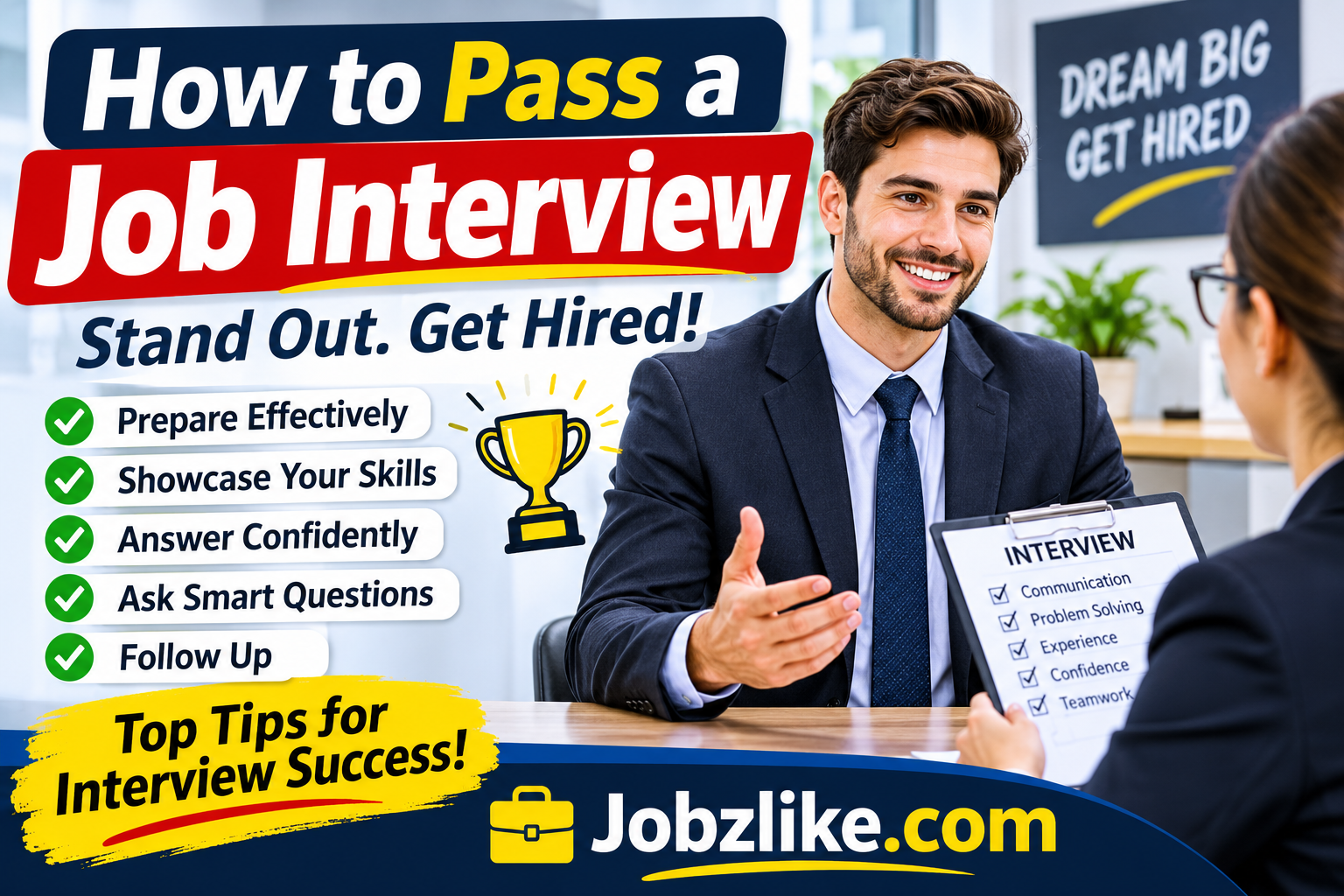
A job interview is an opportunity to show an employer how your experience, knowledge, attitude, and goals match the position. A strong CV may help you receive an interview invitation, but your performance during the conversation often influences the final hiring decision. Many candidates feel nervous because they are unsure what an interviewer will ask or how they should present their answers. The good news is that interview success is not based on luck alone. Preparation, clear communication, professional behaviour, and thoughtful examples can make a meaningful difference.
This complete job interview guide explains how to prepare before the meeting, make a positive first impression, answer common and difficult questions, discuss salary, and follow up professionally. It is useful for fresh graduates, experienced professionals, applicants changing careers, and people applying for public- or private-sector jobs. Every organisation has its own recruitment process, so there is no single answer that guarantees selection. However, learning how to pass a job interview gives you a practical structure for presenting your strengths honestly and confidently. Use the steps in this article to prepare carefully, avoid common mistakes, and help the interviewer understand the value you can bring to the workplace.
Understand the Role and What the Employer Needs
Start by reading the job advertisement from beginning to end. Identify the main duties, required qualifications, experience level, technical abilities, and personal qualities. Then compare these requirements with your own background. An employer is usually looking for evidence that you can perform the work, learn what you do not yet know, and cooperate with the team.
- Highlight the essential skills and qualifications in the vacancy notice.
- Review the responsibilities and identify examples from your work, studies, or training.
- Notice whether the position requires customer service, reporting, fieldwork, teamwork, or technical knowledge.
- Prepare a short explanation of why your background matches the role.
- Check whether the advertisement mentions documents, tests, or other interview stages.
Research the Organisation Before the Meeting
Research helps you give relevant answers instead of relying on general statements. Visit the organisation’s official website and read its About, Services, Careers, and recent news pages. Learn what it does, who it serves, and what values it highlights. For a government vacancy, understand the department’s public responsibilities and the nature of the advertised post. For a private company, explore its products, customers, and industry.
- Learn the organisation’s correct name, location, and main activities.
- Read about its products, services, projects, or public responsibilities.
- Review recent announcements that may relate to the job.
- Understand the organisation’s work culture where reliable information is available.
- Prepare one or two thoughtful questions that show genuine interest.
Prepare a Professional Self-Introduction
“Tell me about yourself” is often one of the first interview questions. The interviewer is not asking for your complete life story. They want a brief professional overview that explains who you are, what you can do, and why you are interested in the position. Keep your response organised and relevant, usually around one minute.
- Begin with your name and current professional or educational status.
- Mention your most relevant qualification or experience.
- Highlight two strengths connected to the advertised role.
- Include a brief achievement, project, or practical example if suitable.
- Finish by explaining why this opportunity interests you.
Practise the introduction aloud, but do not memorise it so rigidly that it sounds unnatural. Adjust the details to match each vacancy.
Choose Suitable Clothes and Organise Your Documents
Your appearance should be neat, comfortable, and appropriate for the organisation. Formal clothing is generally a safe choice for office, administrative, and professional interviews. Some workplaces have a less formal culture, but clean and well-maintained clothes remain important. Prepare your documents the day before so that you are not searching for them at the last moment.
| Item | Why it matters | Preparation tip |
|---|---|---|
| Updated CV | Summarises your qualifications and experience | Carry two or three clean copies |
| CNIC or identification | May be required for entry or verification | Check the interview instructions |
| Educational documents | Support your stated qualifications | Arrange originals and photocopies separately |
| Experience letters | Confirm relevant employment history | Include documents requested by the employer |
| Certificates or portfolio | Show relevant training or work samples | Bring only material related to the role |
Plan Your Journey and Arrive at the Right Time
Being late can create an avoidable negative impression. Confirm the venue, building entrance, interview time, contact number, and any visitor registration requirements. Check the route in advance and allow extra time for traffic, parking, public transport delays, or security procedures. For an online interview, test your internet connection, camera, microphone, and meeting link before the scheduled time.
- Save the venue address and the interviewer’s contact details.
- Plan to arrive around 10 to 15 minutes early, not extremely early.
- Keep your phone charged and set it to silent before entering.
- For online meetings, choose a quiet place with a simple background.
- Keep your CV and notes nearby without reading from them continuously.
Make a Positive First Impression
The interview begins before the first question. Greet the receptionist and interview panel politely, follow the organisation’s instructions, and wait to be invited to sit. Offer a professional greeting, maintain comfortable eye contact, and speak clearly. A natural smile can help you appear approachable. Avoid trying to act overly confident; calm, respectful behaviour is more convincing than exaggerated gestures.
- Greet the interviewer with a polite and clear voice.
- Use a comfortable posture and avoid unnecessary movement.
- Listen carefully instead of interrupting.
- Keep your phone away and avoid checking the time repeatedly.
- Show respect to every person you meet at the workplace.
Use the STAR Method to Explain Your Experience
Behavioural questions ask how you handled a real situation. The STAR method helps you give a complete answer without losing focus. STAR stands for Situation, Task, Action, and Result. Explain the context briefly, describe your responsibility, tell the interviewer what you personally did, and finish with the outcome. Where possible, include a measurable result, such as reducing delays, completing a project early, or improving customer satisfaction.
| Stage | What to explain | Example prompt |
|---|---|---|
| Situation | The background or challenge | What was happening? |
| Task | Your responsibility | What needed to be achieved? |
| Action | The steps you personally took | How did you respond? |
| Result | The outcome and lesson | What changed or improved? |
Answer Common Interview Questions with Clarity
Many interviews include familiar questions, but your answers should still be specific to the vacancy. Avoid one-word replies and long speeches that do not answer the question. Give a direct response, support it with a relevant example, and connect it to the job.
- Why do you want this job? Explain how the duties match your abilities and career direction.
- What are your strengths? Choose strengths that you can demonstrate with examples.
- What is your weakness? Mention a genuine, manageable development area and how you are improving it.
- Why should we hire you? Summarise the relevant skills, experience, and attitude you can contribute.
- Where do you see yourself in five years? Describe realistic professional growth connected to the field.
Handle Difficult Questions Without Losing Confidence
Some questions may feel uncomfortable, especially those about employment gaps, limited experience, previous failures, or leaving a former job. Do not become defensive or invent an answer. Pause briefly, understand what is being asked, and respond honestly. If you do not know something, say so and explain how you would find the correct information or learn the skill.
- For an employment gap, give a truthful and concise explanation, then return to your readiness for work.
- For a past mistake, explain what you learned and what you changed afterwards.
- For limited experience, highlight projects, internships, volunteering, coursework, or transferable skills.
- For a question you do not understand, politely ask the interviewer to clarify it.
- For a technical question you cannot answer, be honest rather than guessing confidently.
Show Your Skills Through Real Examples
Simply claiming that you are hardworking, organised, or good at communication is less persuasive than showing evidence. Prepare examples that demonstrate your abilities. Fresh graduates can use academic projects, internships, student societies, volunteer work, and practical assignments. Experienced applicants can discuss completed projects, targets achieved, process improvements, or responsibilities handled. Protect confidential information when discussing previous employers or clients.
| Skill | Useful evidence |
|---|---|
| Communication | Explaining a project, supporting a customer, or presenting findings |
| Teamwork | Working with colleagues to complete a shared task |
| Problem-solving | Identifying a problem and applying a practical solution |
| Time management | Meeting deadlines while handling competing priorities |
| Technical ability | Using relevant software, equipment, tools, or professional methods |
Fresh Graduate Interview Preparation Compared with Experienced Candidates
Interview preparation should reflect your career stage. A new graduate may have limited employment history but can still demonstrate learning ability, discipline, and practical knowledge. An experienced candidate should show how previous responsibilities and achievements relate to the new role.
| Interview area | Fresh graduate | Experienced candidate |
|---|---|---|
| Evidence | Projects, internships, coursework, volunteering | Work achievements, responsibilities, outcomes |
| Key message | Ability to learn and contribute | Relevant expertise and proven results |
| Examples | Academic or practical assignments | Workplace challenges and solutions |
| Career goals | Building a foundation in the profession | Taking on suitable responsibilities and growth |
| Preparation focus | Role knowledge and transferable skills | Impact, leadership, and role-specific expertise |
Communicate Professionally with the Interview Panel
Good communication is not about using complicated vocabulary. It means understanding the question, organising your thoughts, and speaking in a respectful and understandable way. Keep your answers focused and use professional language. If several people are on the panel, direct your answer to the person who asked while occasionally acknowledging the other members. In a video interview, look towards the camera when speaking and listen without talking over others.
- Speak at a moderate pace and use clear sentences.
- Listen to the complete question before responding.
- Avoid slang, unnecessary jargon, and overly casual language.
- Keep answers relevant and provide examples where helpful.
- Ask for a moment to think if you need to organise your response.
Discuss Salary Expectations in a Professional Way
Salary questions can be challenging because candidates want fair compensation without appearing inflexible. Research typical pay for similar roles, considering location, industry, responsibilities, and your experience. If the vacancy advertises a salary or government pay scale, understand what it includes and whether allowances or benefits are separate. Give a realistic range when appropriate and remain open to discussing the complete compensation package.
- Research market rates before the interview.
- Consider responsibilities, working hours, benefits, and development opportunities.
- Do not claim a previous salary or competing offer that you cannot support.
- If unsure, ask whether the employer has an approved salary range for the position.
- For public-sector roles, refer to the announced scale and official terms rather than assuming take-home pay.
Ask Thoughtful Questions at the End of the Interview
When an interviewer asks whether you have questions, use the opportunity to understand the role. Asking thoughtful questions shows that you are considering how you can contribute. Avoid questions that have already been clearly answered in the advertisement or during the meeting. You can ask about the team’s priorities, training, performance expectations, or the next stage of recruitment.
- What would be the main priorities for the person selected during the first few months?
- How is performance usually evaluated in this position?
- What training or professional development is available?
- Could you explain the team structure and the role’s main working relationships?
- What are the next steps and expected timeline for the recruitment process?
Avoid Mistakes That Can Weaken Your Interview Performance
Even a well-qualified applicant can create doubts by arriving late, giving misleading information, or showing little interest. Review common mistakes before the meeting and make a deliberate effort to avoid them. Professionalism includes honesty, preparation, courtesy, and attention to detail.
- Do not arrive late without contacting the organisation when an unavoidable delay occurs.
- Do not criticise former managers, colleagues, or employers.
- Do not exaggerate qualifications, job titles, or technical abilities.
- Do not interrupt the interviewer or argue aggressively about a question.
- Do not give identical memorised answers that ignore the actual question.
- Do not ask about leave, perks, or promotion before understanding the role, unless the interviewer raises those topics.
Prepare for Online, Telephone, and Panel Interviews
Different interview formats require slightly different preparation. An online interview depends on reliable technology and a suitable environment. A telephone interview requires clear speech because the interviewer cannot see your expressions. A panel interview may involve several people assessing different areas, so remain attentive to everyone and keep your answers structured.
- Online: test the platform, camera, microphone, lighting, and internet connection.
- Telephone: choose a quiet place, keep your CV nearby, and speak clearly.
- Panel: note each questioner’s name or role where possible and share your attention respectfully.
- Technical interview: review core concepts and practise explaining your problem-solving process.
- Practical assessment: read instructions carefully and manage your time.
Follow Up After the Interview and Review Your Performance
A brief thank-you message can reinforce your interest, provided the organisation accepts follow-up communication. Send it through an appropriate channel and avoid repeated calls or messages. If the interviewer provides a decision date, wait until that date has passed before making a polite enquiry. Independently review your performance while the discussion is still fresh so that you can improve for future opportunities.
- Thank the interviewer for their time and consideration.
- Restate your interest in the position in one or two sentences.
- Mention a relevant point from the discussion if it adds value.
- Respect the employer’s stated recruitment timeline.
- Write down questions that were difficult and prepare stronger answers for next time.
Your Final Interview-Day Checklist
A simple checklist can reduce last-minute stress. Complete these tasks before leaving home or joining the online meeting. Adjust the list to the employer’s instructions, because some organisations request specific forms, certificates, or security procedures.
- Review the job description and your CV.
- Practise your introduction and two or three relevant examples.
- Prepare identification, educational records, certificates, and requested documents.
- Confirm the venue or meeting link and check the time.
- Wear clean, appropriate clothing and keep your phone silent.
- Arrive early or sign in a few minutes before the online meeting.
- Listen carefully, answer honestly, and ask relevant questions.
- Thank the panel and note any follow-up instructions.
Conclusion: Turn Preparation into a Strong Interview Performance
Learning how to pass a job interview starts with understanding the position and preparing evidence that proves your suitability. Research the employer, organise your documents, practise a clear self-introduction, and prepare examples using a structured method such as STAR. During the interview, listen carefully, communicate respectfully, answer honestly, and stay calm when questions become difficult. Remember that fresh graduates and experienced professionals can both make a strong impression by connecting their real abilities to the employer’s needs.
No guide can guarantee a job offer, because selection also depends on the employer’s requirements and the other applicants. However, consistent preparation helps you present your qualifications more effectively and learn from every interview. Treat each meeting as a professional conversation and an opportunity to improve. With practice, realistic expectations, and a positive attitude, you can approach your next job interview with greater confidence and a clearer understanding of how to show your value.