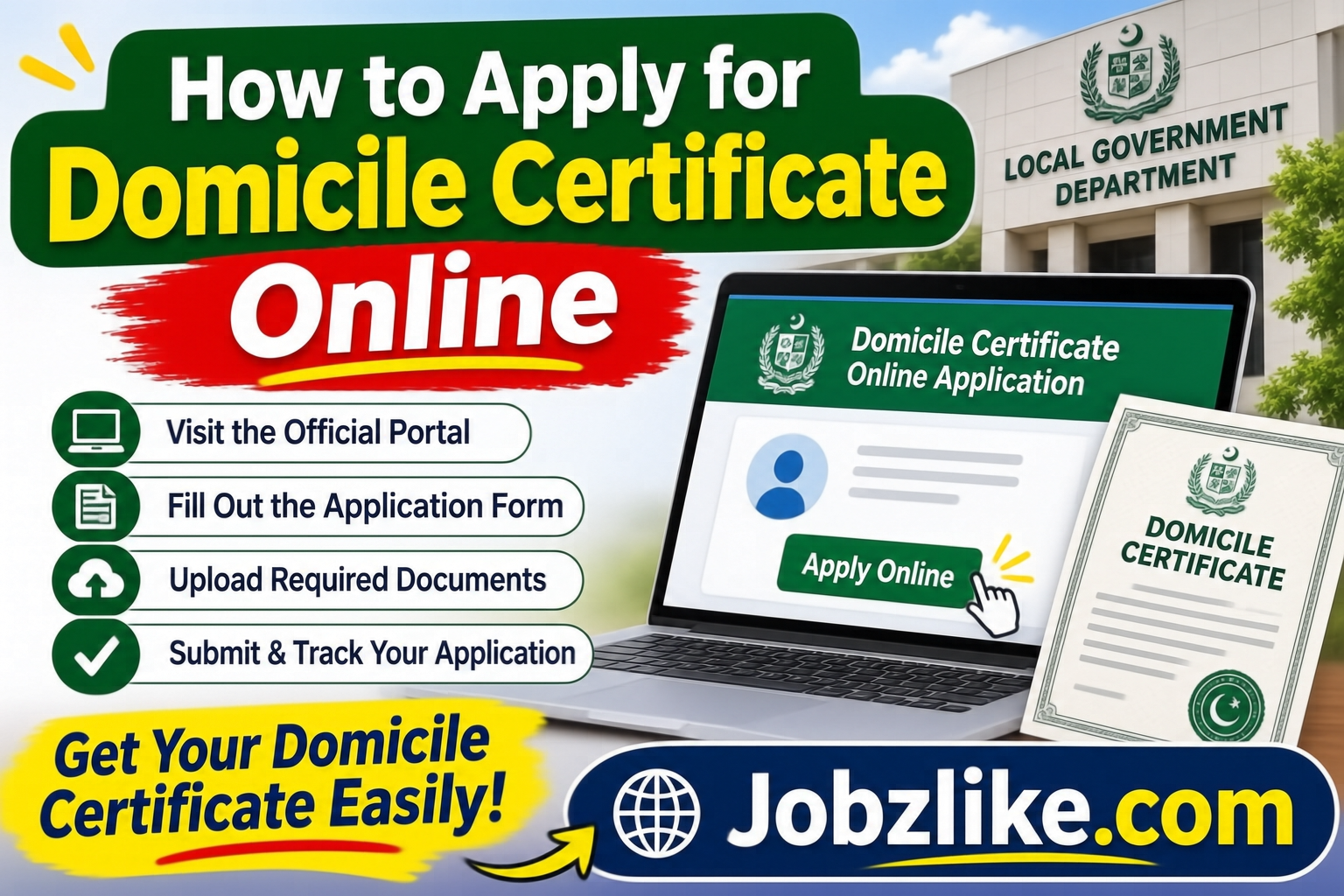
A domicile certificate is one of the most important official documents for Pakistani citizens, particularly students, job seekers, and individuals applying for government employment. It serves as legal proof of a person’s permanent residence in a particular district or province of Pakistan. Whether you are applying for a government job, appearing in a competitive examination, seeking university admission, or benefiting from regional employment quotas, having a valid domicile certificate can be essential. In 2026, the process of obtaining a domicile certificate is becoming more convenient through digital government services and online application systems in different provinces. However, the application procedure, required documents, processing time, and fee structure can vary depending on your district and province.
Some regions offer online applications, while others require applicants to visit designated facilitation centers for document verification and biometric procedures. This comprehensive guide explains how to apply for a domicile certificate online in Pakistan in 2026, including eligibility requirements, necessary documents, application procedures, fees, processing time, benefits, and its importance for government jobs. If you are preparing for upcoming government vacancies, understanding the domicile application process can help you avoid unnecessary delays and complete your employment documentation on time.
What Is a Domicile Certificate and Why Is It Important?
A domicile certificate is an official government document that confirms an individual’s permanent residence in a particular district or area. It is generally issued by the relevant district administration or authorized government department after checking the applicant’s identity and residential information.
In Pakistan, domicile certificates are commonly required for administrative, educational, and employment purposes.
Important features of a domicile certificate include:
- It establishes your permanent residential status in a particular district.
- It helps government departments determine eligibility for regional employment quotas.
- It is frequently required when applying for government jobs.
- It supports applications for public-sector universities and educational institutions.
- It provides official residential information for different administrative purposes.
- It may be required for scholarships and other government-supported opportunities.
A domicile certificate is not the same as a temporary residence certificate. It establishes your recognized permanent district affiliation according to applicable government rules.
Who Is Eligible to Apply for a Domicile Certificate in Pakistan?
Eligibility requirements depend on the rules of the relevant provincial or district administration. Generally, applicants must establish a genuine residential connection with the district where they intend to obtain their domicile.
Common eligibility conditions include:
- Pakistani citizenship.
- Permanent residence in the relevant district.
- Valid CNIC for applicants aged 18 or above.
- B-Form or Child Registration Certificate for minors.
- Supporting residential documents.
- Parent or guardian identification where applicable.
- Compliance with district-specific domicile regulations.
- Cancellation or clearance of an existing domicile where required.
Applicants should understand that simply living temporarily in a city does not automatically establish eligibility for its domicile certificate.
For example, Islamabad Administration requires applicants to provide qualifying residence evidence and generally requires an established CNIC address. Specific exemptions and additional requirements may apply.
Documents Required for Domicile Certificate Application in 2026
Preparing the necessary documents before submitting an application can make the process easier. Government authorities verify personal details, family information, and residential evidence before approving a domicile certificate.
The commonly requested documents include:
- Copy of the applicant’s CNIC.
- Copy of the father’s or mother’s CNIC.
- B-Form for applicants under 18 years of age.
- Two recent passport-size photographs.
- Completed domicile application form.
- Affidavit on the prescribed stamp paper or other accepted format.
- Property ownership documents, where applicable.
- Electricity or gas utility bill.
- Educational certificates or school records.
- Residential certificate issued by the relevant authority, if required.
- Additional verification documents requested by the district administration.
The exact requirements can differ between Punjab, Sindh, Khyber Pakhtunkhwa, Balochistan, and Islamabad. Applicants should always check their relevant official portal before paying any application fee.
Step-by-Step Process to Apply for Domicile Certificate Online
The online domicile application process depends on the province and availability of digital services. Applicants should use government-authorized websites or official mobile applications instead of relying on unofficial agents.
A general online application procedure includes:
- Visit the official domicile application portal of your province.
- Create a new account using your CNIC and registered mobile number.
- Complete mobile verification through an OTP if requested.
- Select the domicile certificate service.
- Enter your personal information, including name, father’s name, date of birth, and permanent address.
- Select the relevant province, district, and tehsil.
- Upload scanned copies of the required documents.
- Review your application carefully before submission.
- Pay the prescribed fee through the available payment method.
- Submit the application and save your tracking or reference number.
- Check your application status regularly.
- Complete any additional verification requested by the relevant authority.
- Download or collect your approved domicile certificate according to the available delivery method.
Applicants should remember that an online form does not necessarily mean that the entire process is completed digitally. Some authorities require physical document verification or personal appearance.
Provincial Online Domicile Application Portals in Pakistan
Pakistan does not have one universal online domicile application system covering every district. Different provincial administrations have introduced their own digital services.
The following table provides an overview of the relevant application channels.
| Province or Region | Official Application Channel | Application Method |
|---|---|---|
| Punjab | e-Khidmat Markaz | Online-supported and facilitation center service |
| Sindh | Sindh Domicile and PRC Portal | Online application in currently supported districts |
| Khyber Pakhtunkhwa | KP Citizens Facilitation Portal | Online application and tracking |
| Islamabad | ICT Administration / Citizen Facilitation Center | Physical application and online verification |
| Balochistan | Relevant Deputy Commissioner Office | Confirm district-specific procedure |
Official websites:
- Punjab: https://ekhidmat.punjab.gov.pk/
- Sindh: https://www.sindhdomicileportal.gos.pk/
- Khyber Pakhtunkhwa: https://cfc.kp.gov.pk/
- Islamabad: https://ictadministration.gov.pk/
Always check the latest district-level instructions because online service availability may change.
How to Apply for Punjab Domicile Certificate Through e-Khidmat Markaz
Punjab residents can use the e-Khidmat Markaz service to apply for a domicile certificate. The official service provides information about required documents, payment, and certificate delivery.
The general procedure includes:
- Visit the official Punjab e-Khidmat website.
- Open the domicile certificate service information.
- Review the required documents.
- Visit the relevant e-Khidmat Markaz or follow the currently available application instructions.
- Submit the application and supporting documents.
- Complete the required identity and residence verification.
- Pay the applicable service charges through the prescribed online payment method.
- Keep the application receipt for future reference.
- Track the application and collect the certificate when issued.
According to the Punjab e-Khidmat service information, the listed service fee is Rs. 200 and the stated delivery time is 16 working days. Fees and district-specific conditions should be reconfirmed before applying.
Official service page: https://ekhidmat.punjab.gov.pk/services/e-khidmat-marakaz/domicile-certificate
Sindh Domicile Certificate Online Application Procedure
The Government of Sindh has introduced a digital domicile and Permanent Residence Certificate portal to simplify the application process.
Applicants belonging to currently supported districts can use the online system.
The application procedure generally involves:
- Open https://www.sindhdomicileportal.gos.pk/.
- Register using your CNIC and mobile number.
- Complete the OTP verification process.
- Select the domicile certificate application.
- Enter the required personal and residential details.
- Upload your CNIC, photograph, utility bill, and other supporting documents.
- Review the information before submission.
- Complete the online fee payment.
- Submit the application for verification.
- Track the application through the portal.
- Receive the approved digital certificate according to the available delivery procedure.
An important point for 2026 is that the portal currently identifies Karachi East, Karachi Central, and Karachi South as supported districts. Applicants from other districts should not submit applications through this service until their district is officially included.
Khyber Pakhtunkhwa E-Domicile Application Through Citizen Portal
Khyber Pakhtunkhwa has introduced an electronic domicile system that allows citizens to submit applications through digital government channels.
The KP Citizens Facilitation Portal provides an online domicile application service connected with the relevant Deputy Commissioner offices.
Applicants can follow these steps:
- Visit https://cfc.kp.gov.pk/.
- Register on the Citizens Facilitation Portal.
- Search for the Domicile Certificate service.
- Open the relevant application section.
- Complete the applicant information.
- Upload the documents mentioned in the official checklist.
- Complete any required identity or biometric verification.
- Submit the application.
- Save the generated application tracking ID.
- Monitor the application status through the portal.
- Follow the instructions for certificate collection or delivery.
KP also provides information about its e-Domicile system through the Provincial Reforms and Public Management Unit.
Official information: https://pmru.kp.gov.pk/e-domicile.php
Difference Between Domicile Certificate and PRC in Pakistan
Many applicants confuse a domicile certificate with a Permanent Residence Certificate (PRC). Although these documents are related to residential status, they are not interchangeable in every administrative or employment process.
| Domicile Certificate | Permanent Residence Certificate |
|---|---|
| Establishes permanent district or regional affiliation. | Provides evidence of permanent residence under the applicable PRC system. |
| Commonly requested for government employment. | Frequently relevant to regional administrative and quota requirements. |
| Issued by the competent domicile authority. | Issued by the relevant authorized administration. |
| Follows applicable domicile regulations. | Follows the relevant PRC rules. |
| May be required for competitive examinations. | May be requested for particular provincial procedures. |
In Sindh, PRC documents are particularly relevant to educational admissions and employment-related residential requirements. Applicants should carefully read the vacancy advertisement to determine whether a domicile, PRC, or both documents are required.
Domicile Certificate Fee Structure and Government Charges
The domicile certificate fee is not necessarily the same throughout Pakistan. Charges can depend on the issuing authority, district, type of application, and additional services.
Some authorities charge a standard service fee, while others may require separate payment for affidavits, forms, verification, or other administrative requirements.
Consider the following information:
- Punjab e-Khidmat lists a Rs. 200 service fee.
- Islamabad ICT Administration lists a Rs. 200 fee.
- Sindh applicants should check the current online fee structure.
- KP applicants should consult the relevant service checklist for applicable charges.
- Duplicate and modification applications may have different fees.
- Additional documentation expenses may apply.
Applicants should avoid paying unofficial charges to agents or individuals claiming to guarantee approval.
Always obtain an official payment receipt and verify the current fee before submitting an application.
How Long Does It Take to Receive a Domicile Certificate?
The processing time depends on the issuing authority and the verification requirements of the applicant’s district.
Applications involving complete documentation and accurate residential information may be processed more smoothly than applications containing missing or inconsistent details.
Important processing considerations include:
- Initial application submission.
- CNIC and identity verification.
- Verification of permanent residential information.
- Review of supporting documents.
- Police or local administrative verification, where applicable.
- Approval by the authorized officer.
- Printing or digital issuance of the certificate.
Punjab e-Khidmat lists a delivery period of 16 working days. Islamabad ICT Administration lists a processing time of seven days. Sindh’s online portal advertises a 7–14 working day processing period for domicile applications.
These are published service estimates, not guaranteed delivery dates for every applicant. Delays can occur if additional verification is necessary.
Importance of Domicile Certificate for Government Jobs in Pakistan
A domicile certificate is extremely important for individuals interested in government employment. Federal and provincial recruitment departments frequently use domicile information to determine whether applicants qualify for particular regional vacancies or reserved quotas.
Common employment-related uses include:
- Applying for provincial government jobs.
- Applying for federal government vacancies with regional quotas.
- Appearing in public service commission examinations.
- Applying for education department vacancies.
- Applying for police department recruitment.
- Applying for health department positions.
- Applying for clerical and administrative vacancies.
- Applying for district-based recruitment opportunities.
- Establishing eligibility for advertised regional positions.
Recruitment organizations such as the Federal Public Service Commission and provincial public service commissions may require domicile information as part of their application and document verification procedures.
Applicants should check every job advertisement because the required domicile district and provincial eligibility conditions can differ.
Benefits of Having a Valid Domicile Certificate
A valid domicile certificate offers several practical advantages in Pakistan. It provides officially recognized residential information that may be needed throughout different stages of education, employment, and public administration.
Some major benefits include:
- Government employment eligibility: It helps establish eligibility for vacancies advertised against particular regional quotas.
- Educational admissions: Public universities and colleges may request domicile documents for admission categories.
- Scholarship applications: Some scholarship programs consider provincial or district eligibility.
- Competitive examinations: Recruitment authorities may request domicile documentation during registration or verification.
- Regional opportunities: It helps applicants establish their permanent district affiliation.
- Administrative verification: It provides an official document supporting residential status.
- Career planning: Having the document ready can reduce delays when applying for jobs.
- Public-sector recruitment: It helps recruitment departments verify an applicant’s relevant regional information.
A domicile certificate does not guarantee employment, admission, or a scholarship. Applicants must also meet the relevant merit and eligibility criteria.
Common Reasons for Domicile Certificate Application Rejection
Sometimes an application is delayed or rejected because of incomplete documentation, incorrect information, or problems with residential verification.
Applicants should carefully check their documents before submitting the form.
Common reasons include:
- Incorrect CNIC information.
- Spelling mistakes in the applicant’s name.
- Incomplete application forms.
- Missing photographs.
- Unclear or outdated residential documents.
- Incorrect district or tehsil selection.
- Missing parent or guardian identification.
- Inconsistent permanent addresses.
- Failure to provide an affidavit when required.
- Duplicate domicile records.
- Existing domicile from another district.
- Failure to complete additional verification.
- Uploading incorrect or unreadable documents.
To avoid rejection, ensure that the information entered in the application matches your official identity documents.
How to Track Your Domicile Certificate Application Status
After submitting an application, applicants should keep their tracking information safe. Most digital application systems provide a reference number, application ID, or CNIC-based tracking facility.
Follow these steps to check your application:
- Open the official application portal.
- Locate the application tracking option.
- Enter your application ID or other requested information.
- Submit the tracking details.
- Review the displayed application status.
- Check whether additional documents are required.
- Follow any instructions issued by the relevant authority.
- Contact the official support department if the application remains pending beyond the stated processing period.
For KP applications, the Citizens Facilitation Portal provides an application tracking facility.
Sindh’s domicile portal also provides a tracking page where applicants can enter their 13-digit application ID or CNIC.
Sindh tracking website: https://www.sindhdomicileportal.gos.pk/track
Domicile Certificate Requirements for Students and Job Seekers
Students and job seekers are among the most common applicants for domicile certificates. However, their documentation requirements may differ depending on their age, residential circumstances, and purpose of application.
| Applicant Category | Commonly Required Documents | Main Purpose |
|---|---|---|
| School Students | B-Form, parents’ CNIC, photographs | Educational records |
| College Students | CNIC or B-Form, residential proof | College admissions |
| University Applicants | CNIC, domicile, academic documents | University admissions |
| Government Job Seekers | CNIC, domicile certificate | Recruitment eligibility |
| Competitive Exam Candidates | CNIC, domicile, educational certificates | Examination registration |
| Scholarship Applicants | CNIC, domicile, academic records | Scholarship eligibility |
| Minor Applicants | B-Form, parent or guardian documents | Domicile application |
Applicants should prepare the documents according to the official checklist rather than assuming that every authority accepts identical paperwork.
Important Rules About Changing or Holding Multiple Domiciles
One of the most important aspects of domicile applications is the restriction on obtaining multiple domiciles in different districts.
Generally, a person cannot legally maintain multiple active domicile certificates from different districts or cities.
Before applying for a new domicile, consider the following points:
- Check whether you already have an existing domicile certificate.
- Do not provide misleading residential information.
- Follow the official cancellation procedure if changing your domicile.
- Obtain an NOC or other clearance if the issuing authority requires it.
- Provide genuine proof of permanent residence.
- Ensure that your CNIC information is consistent with your application.
- Follow the applicable rules regarding district changes.
- Keep copies of cancellation or verification documents.
For example, Islamabad Administration requires applicants with an existing domicile from another district to follow the applicable cancellation process before applying for an Islamabad domicile. Its published instructions also specify a waiting period after cancellation.
Always confirm the relevant rules with your district administration before starting a new application.
How to Verify a Domicile Certificate Online
Certificate verification is important for applicants, recruitment departments, universities, and other organizations that need to confirm document authenticity.
Depending on the issuing authority, verification may be available through an online portal, mobile application, QR code, or relevant district office.
The general verification procedure includes:
- Visit the official verification website.
- Select the domicile verification service.
- Enter the CNIC or certificate information requested.
- Submit the verification request.
- Review the information displayed by the official system.
- Check the issuing authority and certificate details.
- Contact the relevant office if the document cannot be verified.
Islamabad ICT Administration provides domicile verification instructions through the City Islamabad mobile application.
Sindh’s digital portal also describes digitally signed certificates with QR-based verification.
Never rely solely on an unofficial website or a third-party verification service.
Useful Tips for Getting Your Domicile Certificate Without Delays
A properly prepared application can reduce unnecessary visits and documentation problems.
Applicants should follow these practical recommendations:
- Prepare all documents before starting the application.
- Use a valid and active mobile number.
- Make sure your CNIC information is accurate.
- Upload clear photographs and readable document scans.
- Check the district and tehsil carefully.
- Confirm whether an affidavit is required.
- Verify the current application fee.
- Use only official government websites.
- Save the payment receipt and application reference number.
- Respond promptly if the authority requests additional information.
- Check your application status regularly.
- Keep a digital and printed copy of your approved certificate.
If you are applying for government employment, obtain your domicile certificate well before the application deadline.
Frequently Asked Questions About Domicile Certificate in Pakistan 2026
Can I apply for a domicile certificate online in Pakistan in 2026?
Yes, online applications are available through certain provincial and district systems. KP offers an electronic domicile service, while Sindh provides an online portal for selected Karachi districts. Punjab also provides e-Khidmat services.
Can I get a domicile certificate without visiting a government office?
This depends on your district’s digital service arrangements. Some applications can be submitted online, but authorities may still require physical verification, biometric procedures, or personal appearance.
Is a domicile certificate compulsory for government jobs?
Many government vacancies require a domicile certificate, especially where district or provincial quotas apply. However, the exact requirement depends on the recruitment advertisement.
What is the fee for a domicile certificate in Pakistan?
There is no single nationwide fee. Punjab e-Khidmat and Islamabad ICT Administration publish a Rs. 200 fee, while other authorities have their own applicable charges.
Can a student apply for a domicile certificate?
Yes. Eligible students can apply using their CNIC or B-Form, depending on their age, along with the required parental and residential documents.
Can I change my domicile from one district to another?
A change may be possible if you satisfy the relevant legal and administrative requirements. You may need to cancel your previous domicile and obtain an NOC or other clearance.
How can I check whether my domicile certificate is genuine?
Use the official verification service provided by the issuing authority. Some systems support CNIC-based or QR-code verification.
Is domicile required for FPSC and PPSC jobs?
Domicile information is important for many FPSC and PPSC recruitment processes, particularly where regional or provincial eligibility conditions apply. Always read the relevant advertisement.
Conclusion – Apply for Your Domicile Certificate Before Applying for Jobs
Obtaining a domicile certificate in Pakistan in 2026 is an important step for students, job seekers, and citizens who need official proof of their permanent residential status. It plays a significant role in government recruitment, provincial employment quotas, university admissions, scholarships, and other administrative activities. With the introduction of digital government services, applicants in several regions can now access online application and tracking facilities, making the process more convenient than traditional paperwork-based procedures.
However, the application process is not identical throughout Pakistan. Punjab residents can access domicile services through e-Khidmat Markaz, Sindh applicants from selected Karachi districts can use the Sindh Domicile and PRC Portal, and Khyber Pakhtunkhwa residents can apply through the Citizens Facilitation Portal. Islamabad applicants should follow the ICT Administration’s prescribed application procedure, which includes visiting a Citizen Facilitation Center.
Before applying, prepare your CNIC, photographs, residential evidence, affidavit, and other required documents. Always verify the latest fee, eligibility conditions, and processing time through the relevant official government website. If you are planning to apply for upcoming government jobs in 2026, obtaining your domicile certificate in advance can help you complete recruitment documentation without unnecessary delays. A valid domicile certificate is an important document that can support your educational and professional opportunities throughout Pakistan.