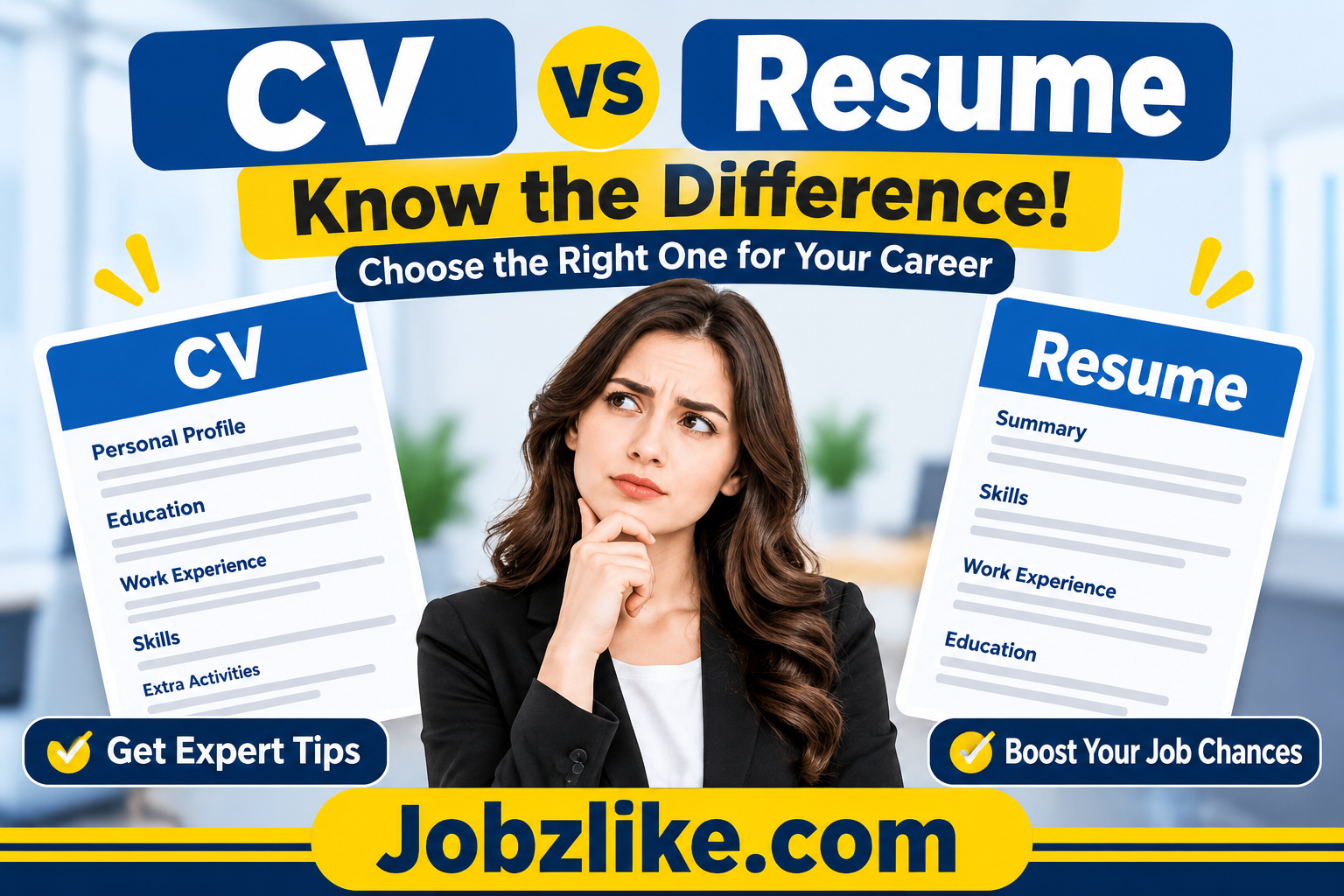
Choosing between a CV and a resume can be confusing, especially when employers, universities, and recruitment websites use the terms differently. Both documents introduce your professional background, explain your qualifications, and help decision-makers understand whether you are suitable for an opportunity. However, they are not always interchangeable. A resume is generally a concise, targeted summary of experience and skills prepared for a particular job. A curriculum vitae, commonly called a CV, is usually a more detailed record of academic history, professional experience, research, publications, certifications, and other relevant achievements. The distinction also depends on the country and industry.
In the United States, employers commonly request a resume for most non-academic roles and a CV for academic or research positions. In the United Kingdom, Pakistan, and several other countries, the word CV is often used for the document submitted when applying for ordinary jobs. This difference in terminology can lead applicants to send the wrong format or prepare a document that does not meet an employer’s expectations. Understanding CV vs resume differences helps you choose the right structure, include relevant information, and present your experience clearly. This guide explains how each document works, when to use it, what to include, and how to adapt your application to different recruitment systems.
What a Curriculum Vitae Reveals About Your Career
A curriculum vitae is a structured overview of your education, professional journey, and relevant accomplishments. The Latin phrase means “course of life,” reflecting its purpose as a broader record of academic and professional development. A CV may include degrees, research projects, teaching roles, conference presentations, publications, professional memberships, awards, and employment history. Its length depends on the applicant’s experience and the expectations of the field. A recent graduate may have a short CV, while an experienced researcher may need several pages to document years of work. The goal is not to include every personal detail but to provide a complete and accurate record of information relevant to the opportunity.
- Present a detailed record of academic qualifications and professional development.
- Show research, teaching, publications, presentations, and specialist achievements when relevant.
- Provide a chronological account of relevant employment and responsibilities.
- Support applications for academic, research, scientific, and specialist positions.
- Make qualifications easy to verify through clear dates, institutions, and descriptions.
How a Resume Communicates Your Professional Value
A resume is a focused marketing document designed to show why you are a strong candidate for a particular vacancy. Instead of recording every stage of your career, it highlights the experience, abilities, and results most closely connected to the job description. Recruiters often review many applications in a limited amount of time, so a resume should be concise, readable, and easy to scan. It normally includes a professional summary, employment history, key skills, education, and selected achievements. The strongest resumes use specific examples and measurable results rather than vague statements. Explaining that you improved customer response time by 20 percent, for example, gives an employer more useful information than simply saying you have good communication skills.
- Focus on experience that matches the role being advertised.
- Use achievement-based bullet points to demonstrate results.
- Keep the layout simple, consistent, and readable on different devices.
- Adjust the summary and skills section for each important application.
- Remove unrelated details that do not strengthen your candidacy.
Why CV Terminology Changes Across Countries
Employers do not use the same terminology worldwide. In the United States and Canada, “resume” usually refers to a short job application document, while “CV” commonly describes a longer academic or research record. In the United Kingdom, Ireland, Pakistan, India, Australia, and many other markets, “CV” is frequently used for the document submitted for standard professional vacancies. That document may look very similar to an American resume. Therefore, the correct choice is not determined by the word alone. Read the vacancy instructions, consider the country where the employer operates, and follow any stated page or format requirements. If an employer specifically requests a CV, do not assume it wants an academic document unless the role or instructions indicate that.
- United States: resumes are common for most jobs; academic and research applications often request a CV.
- United Kingdom: CV is the usual term for many professional job applications.
- Pakistan: employers commonly use CV for general private-sector and public-sector applications.
- Canada: resumes are widely used for employment, while academic CVs are more detailed.
- Australia: resume is common, although some employers also use the term CV.
CV vs Resume: The Main Differences at a Glance
The documents share several sections, but their purpose, level of detail, and typical length can differ. Treat these points as general guidance rather than fixed rules because local recruitment practices and employer instructions take priority.
| Feature | CV | Resume |
|---|---|---|
| Main purpose | Detailed academic and career record | Targeted job application summary |
| Typical length | Can extend to several pages | Often one or two pages |
| Content focus | Qualifications, research, career history, publications | Relevant skills, experience, and achievements |
| Customization | Core record is relatively comprehensive | Usually tailored closely to each vacancy |
| Common use | Academic, research, and markets that use CV as the standard term | Most non-academic jobs in markets that distinguish the terms |
| Updating | Add new qualifications and career milestones | Revise emphasis for each application |
When Employers Expect a CV Instead of a Resume
A CV is often the right choice when the employer needs a broad view of your academic or specialist background. Universities may request it to assess teaching experience, research interests, publications, grants, and conference participation. Research institutes may need evidence of technical projects, laboratory experience, or scholarly contributions. Medical, scientific, and certain international recruitment processes may also ask for a detailed CV. In countries where CV is the normal term for a job application document, follow that convention even if the requested file is relatively short. Always review the vacancy announcement because some employers specify a template, required sections, or maximum length.
- Applying for a university lecturer, professor, or academic researcher position.
- Seeking a research fellowship, postdoctoral role, or funded academic opportunity.
- Submitting an application that asks for publications, conference papers, or research grants.
- Applying in a country where CV is the standard name for job application documents.
- Responding to an employer that explicitly requests a comprehensive career history.
Situations Where a Resume Is Usually the Better Choice
In countries where employers distinguish between the two documents, a resume is generally suitable for private-sector roles outside academia. Business, sales, administration, customer service, finance, marketing, information technology, and many operational positions usually require a concise overview of relevant experience. A resume helps recruiters identify your fit without searching through unrelated academic or career details. For an experienced professional, it can emphasize leadership, project delivery, revenue growth, cost savings, technical expertise, or customer outcomes. For a new applicant, it can highlight education, internships, volunteer work, projects, and transferable skills.
- Applying for a corporate, commercial, or administrative vacancy in the United States.
- Seeking a role where recent practical achievements matter more than a full academic record.
- Changing careers and needing to emphasize transferable experience.
- Applying through a recruitment platform that specifically requests a resume.
- Responding to an employer that sets a short page limit.
Essential Sections to Include in a Strong CV
The right CV sections depend on your profession, experience, and the role. Academic applicants may need research interests and publications, while a general professional CV may focus on employment, skills, and education. Use clear headings and put the most relevant information where readers can find it quickly. Avoid adding sections simply to make the document longer.
| Section | What to include | Practical advice |
|---|---|---|
| Contact information | Name, professional email, phone, location, relevant portfolio | Use accurate details and a professional email address. |
| Profile or objective | A short description of expertise and career direction | Make it specific to the opportunity. |
| Education | Degrees, institutions, dates, relevant distinctions | List the most recent qualification first. |
| Work experience | Employers, job titles, dates, responsibilities, results | Use action verbs and concrete examples. |
| Research and publications | Projects, papers, journals, presentations | Include genuine, verifiable contributions. |
| Skills and certifications | Technical, language, professional, and licensed skills | Prioritize skills relevant to the vacancy. |
Building a Resume Recruiters Can Scan Quickly
A resume should guide the reader through your strongest evidence of suitability. Place your name and contact details at the top, followed by a short summary when it adds value. Your experience section should describe what you achieved, not only what your job required. Use consistent dates, readable spacing, and familiar section names. A clean design is usually more effective than decorative graphics, complicated columns, or excessive colors. If you are applying online, use a file format requested by the employer and make sure the text remains selectable.
- Choose a clear professional heading and accurate contact information.
- Write a concise summary that reflects the vacancy’s main requirements.
- Show recent and relevant work experience before less relevant details.
- Describe outcomes with figures when you can support them accurately.
- Include technical tools, languages, and certifications that matter to the role.
- Proofread the document and check its appearance as a PDF before sending.
Comparing CV and Resume Length, Layout, and Detail
Length is one of the most visible differences, but it should not be treated as a universal rule. A general job CV in Pakistan or the UK may be two pages, while an academic CV can be much longer. A resume in the United States is often one page for early-career candidates and one or two pages for experienced professionals. The correct length is the shortest format that communicates the evidence an employer needs. Do not remove important achievements merely to meet an arbitrary page count, and do not add filler to make a document appear more impressive.
| Applicant profile | Possible document length | What deserves attention |
|---|---|---|
| Student or recent graduate | One page or concise two-page CV | Education, projects, internships, skills |
| Early-career professional | One to two pages | Relevant experience and measurable contributions |
| Experienced manager | One to three pages, depending on market | Leadership, business outcomes, major responsibilities |
| Academic researcher | As long as relevant evidence requires | Research, teaching, publications, grants, presentations |
| Specialist professional | Based on employer instructions | Licenses, projects, technical expertise, compliance |
How Applicant Tracking Systems Read Your Application
Many employers use applicant tracking systems to collect applications and help recruiters organize or search candidate information. These systems vary, so no format can guarantee selection. A straightforward document with standard headings and readable text is generally a sensible choice. Avoid placing essential details only in images, icons, or complex graphics. Use keywords from the vacancy naturally when they accurately describe your experience. Do not copy the entire job description or list skills you do not possess. Before submitting, check that the document can be opened, searched, and read in the format requested by the employer.
- Use standard headings such as Work Experience, Education, and Skills.
- Include relevant job-description terms where they truthfully match your background.
- Avoid complex tables, text boxes, and decorative elements for important information.
- Use a common font and consistent formatting throughout.
- Follow instructions about Word documents, PDFs, file size, and file naming.
Choosing the Right Document for Different Career Fields
Industry expectations can help you decide what to prepare. A software developer applying to a technology company may need a resume emphasizing programming languages, systems, and delivered projects. A university researcher may need a CV documenting publications, teaching, and research grants. A nurse or other licensed professional should follow the requirements of the employer and local regulator, making licenses and relevant experience easy to verify. In countries where CV is the standard term, the same content may be requested under that name.
| Career field | Common document approach | Important information |
|---|---|---|
| Software and IT | Targeted resume or local-market CV | Technical stack, projects, measurable outcomes |
| University teaching | Academic CV | Teaching, research, publications, qualifications |
| Sales and marketing | Targeted resume or local-market CV | Revenue, campaigns, customer growth, results |
| Healthcare | Employer-required CV or resume | Registration, licenses, clinical skills, experience |
| Scientific research | Detailed CV | Methods, projects, papers, grants, presentations |
| Administration | Concise resume or local-market CV | Organization, systems, communication, accuracy |
Common Mistakes That Can Weaken Either Document
Even a well-qualified applicant can make a poor impression through avoidable document errors. One common problem is sending the same generic file for every vacancy without checking whether its content matches the role. Another is describing duties without explaining results. Applicants sometimes include outdated contact details, inconsistent employment dates, spelling mistakes, or unsupported claims. A CV or resume should be honest, current, and easy to verify. Personal information should be limited to what the employer legitimately requests and what is customary in the relevant market.
- Using a document format that conflicts with the employer’s instructions.
- Including inaccurate dates, qualifications, job titles, or achievements.
- Writing long paragraphs that make key information difficult to locate.
- Adding irrelevant personal details or unrelated work history.
- Using the same objective statement for every application.
- Submitting a file with spelling errors, broken formatting, or an unclear filename.
Adapting Your CV or Resume for an International Application
International applications require more than changing the document title. Employers may have different expectations about language proficiency, qualification names, dates, contact details, and work authorization. Explain qualifications in a way that can be understood internationally, but never claim an equivalency you have not verified. Use the language requested in the vacancy and consider whether the employer expects a local address, a portfolio link, or information about relocation. Check whether a photograph, date of birth, or other personal detail is requested or customary before including it. When in doubt, prioritize the official application instructions and local employment norms.
- Use the spelling and terminology common in the employer’s country.
- Explain unfamiliar qualifications with accurate descriptions.
- State language proficiency honestly and consistently.
- Check visa, work authorization, and relocation questions separately.
- Follow local guidance about photographs and personal information.
- Use a professional translation if the employer requires another language.
What Students and Fresh Graduates Should Prepare
Applicants with limited employment history can still create persuasive documents. A student CV or resume should emphasize relevant education, practical projects, internships, volunteer work, part-time jobs, and transferable skills. Explain what you personally contributed to a group project and identify tools or methods you used. If you completed a final-year project, describe its purpose, your responsibilities, and the outcome. Avoid presenting ordinary coursework as professional employment. Honesty and clear examples are more valuable than exaggerated experience.
- Identify the role or study opportunity you want to pursue.
- Review its requirements and select the most relevant academic or practical evidence.
- Describe projects with your contribution, tools, and outcomes.
- Add internships, volunteering, leadership, and relevant short courses.
- Ask a trusted reviewer to check clarity, grammar, and formatting.
Updating Your Career Document as Your Experience Grows
Your CV or resume should develop as your career changes. Save a complete master record of jobs, projects, training, awards, publications, and measurable achievements. This private record can be longer than the document you submit. When a suitable vacancy appears, select the information that supports that application and remove material that distracts from it. Update dates and contact information regularly, and check that professional links still work. Keeping a master record makes each application easier to prepare and reduces the risk of forgetting valuable achievements.
- Record new responsibilities and results while they are still easy to remember.
- Update certifications, licenses, education, and professional memberships.
- Remove outdated skills that you can no longer confidently demonstrate.
- Keep a master document and create a tailored copy for each application.
- Review your document after promotions, career changes, or major projects.
Writing a Clear Professional Profile for Your Application
Your opening profile can help a recruiter understand your professional direction before reading the full document. Keep it brief and relevant, and avoid unsupported claims such as calling yourself the best candidate. Mention your area of expertise, level of experience, and one or two strengths that relate directly to the vacancy. For a CV used in an academic setting, the profile may describe research interests or teaching expertise. For a resume, it should quickly connect your experience with the employer’s needs. If you are a student or changing careers, focus on relevant training, projects, and transferable abilities rather than apologizing for limited experience.
- Use two to four concise sentences rather than a long personal statement.
- Include your professional area and the type of opportunity you are pursuing.
- Support strengths with evidence elsewhere in the document.
- Avoid generic phrases that could describe almost any applicant.
- Revise the profile when applying for a substantially different role.
Practical Checklist Before Sending Your Application
A final review helps ensure that the document is suitable for the vacancy and technically ready to submit. Compare the file with the job advertisement rather than relying only on a general template. Check the title, contact details, dates, spelling, and file format. Make sure the most relevant information appears early and that every claim can be explained in an interview. If the employer provides a specific form or application portal, complete it as instructed even when you are also attaching a CV or resume.
- The document type follows the employer’s terminology and instructions.
- The summary and key skills relate directly to the opportunity.
- Employment dates, education details, and contact information are correct.
- Achievements are specific, relevant, and truthful.
- The layout is consistent and readable on a computer and mobile device.
- The requested file format and filename are used.
- Any required cover letter, portfolio, references, or supporting documents are included.
Quick Decision Guide: Which One Should You Use?
When the distinction is unclear, start with the vacancy announcement. If it requests a resume and the employer is in a market that distinguishes resumes from academic CVs, prepare a concise, targeted resume. If it requests an academic CV, provide a detailed record of your scholarly and professional work. If the employer is based in Pakistan, the UK, or another market where CV is the common term for job applications, a conventional professional CV may be exactly what it expects. When instructions are missing, examine the role, country, and industry. You can also contact the recruiter politely to confirm the preferred format rather than making assumptions.
- Follow the exact document name and format stated in the vacancy.
- Use a detailed academic CV for research and university applications when requested.
- Use a concise, targeted resume for non-academic roles in markets that use that distinction.
- Use a professional CV for ordinary job applications where that is the local convention.
- Ask the employer if the instructions are genuinely unclear.
Conclusion: Make Your CV or Resume Match the Opportunity
The difference between a CV and a resume is mainly about purpose, detail, and regional hiring conventions. A CV often provides a broader account of academic and professional development, while a resume presents a shorter selection of experience and achievements relevant to a particular job. However, terminology varies significantly between countries, and many employers use CV to describe the standard job application document. The most reliable approach is to read the vacancy carefully, understand the employer’s location and industry, and follow its instructions. Build an accurate master record of your education, skills, experience, and accomplishments, then adapt the document for each opportunity. Keep the design clear, use evidence rather than exaggerated claims, and proofread before submitting. Whether you call it a CV or a resume, its purpose is the same: to help an employer understand your value and decide whether to invite you to the next stage. Choose the format that makes your strongest relevant qualifications easy to find.