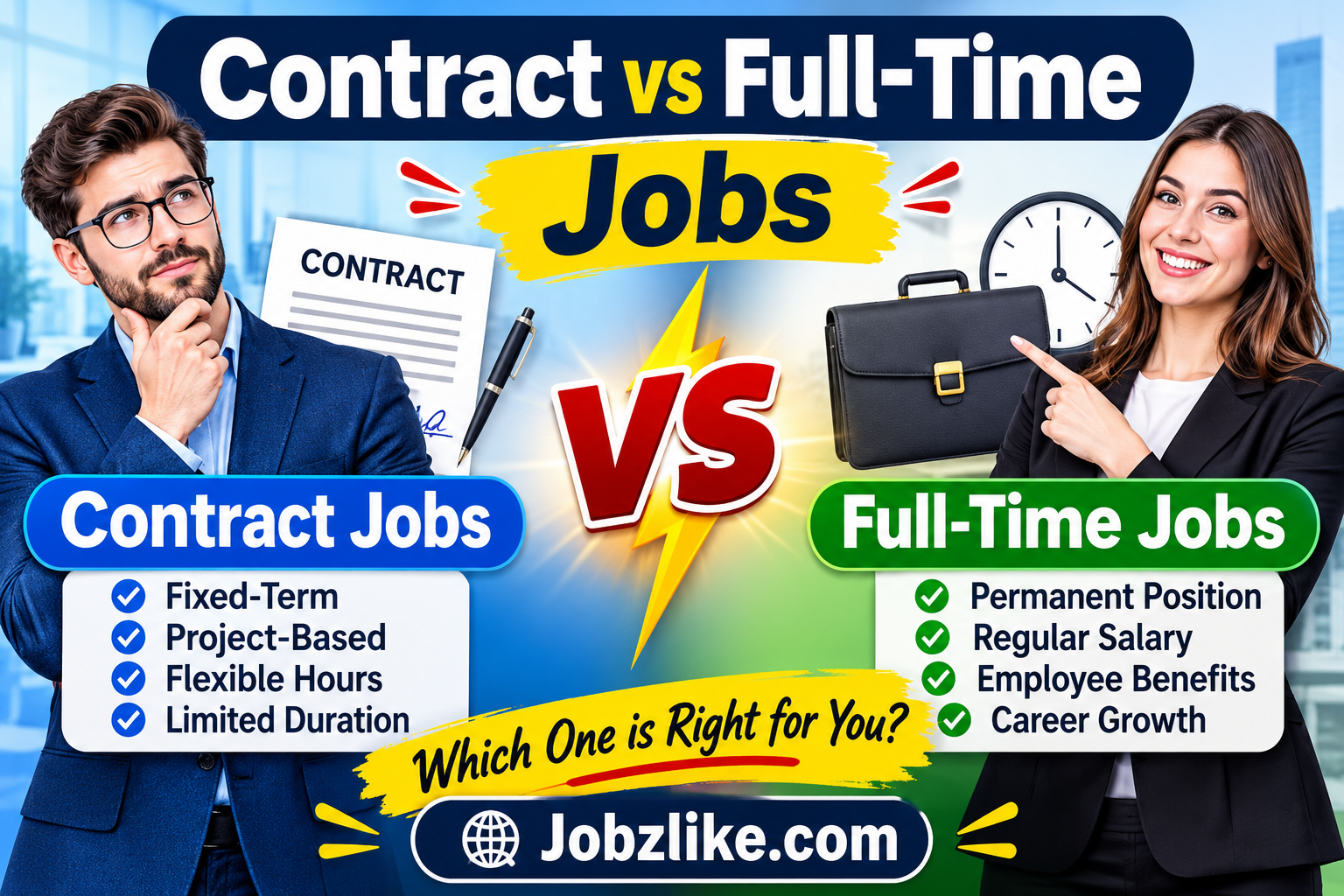
Choosing between contract and full-time employment is an important career decision for job seekers, fresh graduates, experienced professionals, and people looking for better earning opportunities. Both employment options offer different benefits, responsibilities, salary structures, and working conditions. Contract jobs are generally offered for a specific period, project, or business requirement, while full-time jobs usually provide ongoing employment with regular working hours and a more stable professional relationship.
Understanding contract vs full-time jobs can help candidates select an employment arrangement that matches their financial needs, career goals, professional skills, and personal circumstances. Some employees prefer contract positions because they offer flexibility, project-based experience, and opportunities to work with different organizations. Others choose full-time employment because it may provide consistent monthly income, paid leave, health insurance, retirement benefits, and long-term career development.
Before accepting a job offer, candidates should carefully review salary packages, employment agreements, contract duration, termination policies, working hours, and additional benefits. The best option depends on the employer, industry, job responsibilities, and applicable employment laws.
In this detailed guide, we will explain contract vs full-time jobs, their major differences, salary structures, employment types, advantages, disadvantages, selection rules, and important terms and conditions. Whether you are applying for your first job or considering a career change, this comparison will help you make a more informed employment decision.
What Are Contract Jobs and How Does Contract Employment Work?
Contract employment refers to a working arrangement in which an employer hires an individual for a predetermined period, specific project, or defined business requirement. The employee agrees to complete assigned responsibilities under the conditions mentioned in the employment agreement.
Contract positions are commonly available in information technology, construction, education, healthcare, engineering, administration, marketing, customer support, and other professional sectors.
Important characteristics of contract jobs include:
-
Fixed employment duration, such as three months, six months, or one year.
-
Clearly defined job responsibilities and performance expectations.
-
Salary payments according to the agreed compensation structure.
-
Possibility of contract renewal depending on organizational requirements.
-
Employment termination according to the conditions mentioned in the agreement.
-
Opportunities to gain experience through different projects and organizations.
-
Limited or different employee benefits compared with permanent positions.
-
Project-based assignments that may end after completing specific objectives.
Contract employees should carefully read their agreements before joining because employment conditions differ between companies and countries.
Understanding Full-Time Employment in Modern Organizations
Full-time employment is a traditional working arrangement in which an individual works a regular schedule for an organization. Employees are generally hired for ongoing positions rather than temporary projects.
A full-time employee usually receives a monthly salary and may qualify for additional employment benefits depending on company policies and applicable laws.
Common features of full-time jobs include:
-
Regular working hours according to organizational policies.
-
Monthly salary payments and established compensation structures.
-
Opportunities for promotions and professional development.
-
Paid annual, casual, and sick leave where applicable.
-
Employer-provided benefits according to eligibility rules.
-
Greater opportunities for long-term employment stability.
-
Performance evaluations and annual salary reviews.
-
Access to internal training and professional development programs.
Full-time positions are available in government departments, private companies, banks, hospitals, universities, schools, manufacturing industries, and multinational organizations.
Major Reasons Employees Choose Contract-Based Careers
Contract employment has become an attractive option for professionals who want to explore different workplaces and develop specialized skills.
Many employers also hire contract workers when they need additional staff without creating permanent positions.
Some important reasons people choose contract jobs include:
-
Flexible career opportunities: Candidates can accept assignments that match their professional interests.
-
Specialized experience: Contract projects allow employees to develop practical industry knowledge.
-
Short-term commitments: Workers can complete an assignment without committing to a long-term position.
-
Competitive compensation: Certain specialized contract roles offer higher hourly or project-based rates.
-
Professional networking: Working with different organizations helps employees establish useful industry connections.
-
Career exploration: Professionals can experience different industries before selecting a long-term career path.
-
Independent working opportunities: Some contracts provide greater control over schedules and project responsibilities.
-
Skill development: Employees can learn new technologies, management methods, and professional techniques.
However, contract workers should prepare financially for possible employment gaps between assignments.
Why Full-Time Jobs Remain Popular Among Job Seekers
Full-time employment continues to attract candidates because it can provide financial consistency, professional development, and long-term organizational relationships.
For individuals with family responsibilities or regular financial commitments, predictable monthly income can be particularly valuable.
The following benefits make full-time jobs attractive:
-
Regular income that supports monthly budgeting.
-
Opportunities to develop a long-term professional career.
-
Potential eligibility for medical insurance and other benefits.
-
Paid holidays and leave according to employment policies.
-
Greater involvement in organizational projects.
-
Opportunities for internal promotions and leadership positions.
-
Access to company-sponsored training programs.
-
Professional relationships with colleagues and management.
-
Potential retirement contributions and other financial benefits.
The actual benefits depend on the employer, employment agreement, job classification, and local employment regulations.
Contract vs Full-Time Jobs: Basic Employment Information
Understanding the basic differences between these employment arrangements makes it easier to evaluate job opportunities.
| Employment Feature | Contract Jobs | Full-Time Jobs |
|---|---|---|
| Employment duration | Fixed or project-based | Generally ongoing |
| Working hours | Defined by agreement | Usually regular schedule |
| Salary structure | Hourly, monthly, or project-based | Usually monthly |
| Job security | Depends on contract duration | Generally more stable |
| Paid leave | Depends on agreement and law | Often available |
| Medical benefits | May be limited or unavailable | May be provided |
| Retirement benefits | Depends on employment status | May be available |
| Contract renewal | May require renegotiation | Usually not required |
| Career development | Project-dependent | Often includes internal opportunities |
| Termination | According to contract terms and law | According to employment policies and law |
Neither employment arrangement is automatically better. Candidates should compare the actual compensation, responsibilities, benefits, and working conditions before making a decision.
Different Types of Contract Employment Available in the Job Market
Contract employment includes several arrangements designed to meet different business requirements. Understanding these categories helps candidates identify suitable opportunities.
Common types include:
-
Fixed-term contracts: Employment continues for a specified period, such as six months or one year.
-
Project-based contracts: Employees work until a particular project or assignment is completed.
-
Freelance contracts: Independent professionals provide services to clients under agreed conditions.
-
Temporary contracts: Employers hire workers to manage short-term staffing requirements.
-
Seasonal contracts: Employment is offered during specific business seasons or periods.
-
Consultancy agreements: Specialists provide professional advice and technical assistance.
-
Retainer contracts: Clients pay professionals for ongoing access to their services.
-
Renewable contracts: Employment agreements may be extended after reviewing performance and organizational requirements.
Each arrangement has different legal and financial implications. Candidates should determine whether they are classified as employees, independent contractors, or another category under applicable laws.
How Contract and Permanent Employees Receive Their Salaries
Salary is one of the most important factors when comparing contract and full-time employment. However, the highest advertised salary does not always represent the best financial opportunity.
Contract employees may receive higher hourly rates because their compensation could need to account for unpaid holidays, insurance, retirement savings, and periods without assignments.
Full-time employees may receive lower basic salaries but additional financial benefits.
| Salary Component | Contract Employment | Full-Time Employment |
|---|---|---|
| Basic compensation | Agreed contract rate | Fixed salary package |
| Payment schedule | Weekly, monthly, or milestone-based | Usually monthly |
| Overtime payment | According to agreement and law | According to policy and law |
| Annual increment | Depends on renegotiation | May follow annual reviews |
| Bonuses | Depends on contract | May be included in benefits |
| Paid holidays | Depends on agreement and law | Often included |
| Medical coverage | Depends on arrangement | May be employer-sponsored |
| Retirement contributions | Depends on classification and law | May be available |
| Tax deductions | Depends on employment status | Often handled through payroll |
Job seekers should compare total annual compensation rather than focusing exclusively on monthly salary.
Important Advantages of Working Under a Contract
Contract employment offers several advantages for professionals who value flexibility and specialized assignments.
Some major advantages include:
-
Opportunity to work with multiple employers.
-
Exposure to different business environments.
-
Possibility of negotiating project-specific compensation.
-
Opportunities to develop technical and professional skills.
-
Short-term commitments for specific assignments.
-
Potential to build a strong professional portfolio.
-
Experience working on specialized projects.
-
Opportunities to explore different career directions.
-
Possibility of converting into permanent employment when an employer offers such an arrangement.
-
Greater independence in certain freelance and consultancy roles.
Contract employment can be particularly suitable for experienced professionals who have specialized skills and can independently manage their workload.
Disadvantages of Contract Employment Every Candidate Should Consider
Although contract jobs offer flexibility, they also involve certain risks that candidates should understand before accepting an offer.
Important disadvantages include:
-
Employment may end when the agreed contract expires.
-
Contract renewal is not always guaranteed.
-
Income can become irregular between assignments.
-
Some positions do not include paid annual leave.
-
Medical insurance may not be provided.
-
Employees may need to arrange their own retirement savings.
-
Finding new assignments requires additional effort.
-
Short-term positions may offer limited promotion opportunities.
-
Contract conditions may restrict outside professional activities.
-
Sudden changes in project requirements can affect workload.
Candidates should maintain emergency savings and carefully review termination clauses before accepting contract-based employment.
Benefits of Choosing a Long-Term Full-Time Position
Full-time employment provides several advantages for people seeking predictable working conditions and continuous career development.
Some notable benefits include:
-
Consistent monthly income.
-
Greater employment continuity.
-
Potential access to employer-sponsored insurance.
-
Paid leave according to company policies.
-
Opportunities for professional training.
-
Internal promotion opportunities.
-
Better integration into organizational teams.
-
Possibility of receiving annual bonuses.
-
Access to company resources and workplace facilities.
-
Opportunities to develop long-term professional relationships.
For candidates who prefer structured workplaces and stable career progression, full-time employment can be an attractive option.
Potential Drawbacks of Full-Time Employment
Full-time employment also has disadvantages that may affect professional satisfaction and personal flexibility.
Common challenges include:
-
Fixed working hours may reduce schedule flexibility.
-
Employees may have fewer opportunities to work with different companies.
-
Some organizations offer limited salary negotiation opportunities.
-
Workplace policies can restrict independent professional activities.
-
Daily commuting may increase personal expenses.
-
Employees may experience pressure from organizational targets.
-
Promotions and salary increases are not guaranteed.
-
Some positions involve repetitive responsibilities.
-
Changing employers may require a longer transition process.
Before accepting a permanent position, candidates should evaluate the work environment, management structure, salary package, and career development opportunities.
Which Employment Arrangement Offers Better Job Security?
Job security is a major consideration when selecting between contract and full-time positions.
Full-time employment generally provides greater continuity because the position is not automatically scheduled to end on a predetermined date. However, permanent employment does not mean an employee can never be dismissed.
Contract employment has a defined duration or completion requirement. Once that period ends, the employer may decide whether to renew the agreement.
Important factors affecting job security include:
-
Financial stability of the employer.
-
Availability of future projects.
-
Business performance and organizational restructuring.
-
Employee performance and professional skills.
-
Contract renewal conditions.
-
Notice periods and termination clauses.
-
Applicable employment protection laws.
Candidates should remember that a permanent job can also be affected by layoffs, restructuring, or business closures. Similarly, experienced contract professionals with strong industry demand may maintain continuous employment through successive projects.
Contract vs Full-Time Jobs: Complete Comparison of Working Conditions
Working conditions can influence professional productivity, personal satisfaction, and overall career development.
The following comparison explains how these employment arrangements may differ.
| Comparison Factor | Contract Jobs | Full-Time Jobs |
|---|---|---|
| Schedule flexibility | May be flexible depending on agreement | Usually more structured |
| Work environment | Can change between projects | Generally consistent |
| Employer relationship | Assignment-specific | Ongoing organizational relationship |
| Performance reviews | Based on contract requirements | Often conducted periodically |
| Training opportunities | May be project-specific | May include company training |
| Career progression | Often depends on external opportunities | May include internal promotions |
| Workload | Can increase during project deadlines | Depends on regular responsibilities |
| Workplace policies | Contract-specific | Company-wide policies |
| Professional networking | Across multiple organizations | Within a consistent organization |
| Employment continuity | Depends on new assignments | Generally more continuous |
Candidates should compare actual job descriptions because some contract positions offer excellent working conditions, while some full-time roles provide limited flexibility.
Essential Contract Terms and Conditions Before Joining
An employment contract is an important legal document that explains the relationship between an employer and an employee. Reading it carefully helps prevent misunderstandings.
Before signing a contract, candidates should review:
-
Job title and designation: Confirm the official position and reporting structure.
-
Contract duration: Check the start date and end date.
-
Salary details: Understand the payment amount and payment schedule.
-
Job responsibilities: Review the duties and expected deliverables.
-
Working hours: Confirm daily and weekly working schedules.
-
Overtime conditions: Understand additional payment arrangements.
-
Leave policy: Check eligibility for annual, sick, and other leave.
-
Confidentiality requirements: Understand restrictions on sharing business information.
-
Intellectual property: Review ownership of work, inventions, and project materials.
-
Termination conditions: Check how the agreement can legally end.
-
Notice period: Understand the required notice from either party.
-
Dispute resolution: Review the procedure for handling disagreements.
Never sign an agreement containing unclear salary information or responsibilities that differ significantly from the original job offer.
Rules for Selecting the Right Job According to Your Career Goals
Selecting an employment arrangement requires more than comparing salary packages. Candidates should evaluate their professional objectives and personal circumstances.
Important selection rules include:
-
Choose contract employment if you prefer project-based work and can manage periods between assignments.
-
Select full-time employment if regular income and long-term organizational involvement are priorities.
-
Consider contract positions when developing specialized professional experience.
-
Evaluate permanent opportunities when seeking structured promotion pathways.
-
Compare total compensation, including insurance, leave, bonuses, and retirement benefits.
-
Check whether the employer has a reliable payment history.
-
Review the possibility of contract renewal or permanent conversion.
-
Consider commuting costs and working arrangements.
-
Evaluate the employer’s reputation and workplace culture.
-
Make sure the position supports your long-term career objectives.
The right decision should balance financial security, professional development, working conditions, and personal responsibilities.
How to Evaluate a Job Offer Before Accepting Employment
Receiving a job offer is an important professional milestone. However, candidates should avoid accepting an opportunity without reviewing its complete terms.
Follow these practical steps:
-
Read the complete offer letter.
-
Verify the employer’s name and business information.
-
Confirm the job title and reporting manager.
-
Compare the advertised salary with the written offer.
-
Check the expected joining date.
-
Understand the probation period, if applicable.
-
Review working hours and attendance requirements.
-
Confirm available employee benefits.
-
Ask about salary deductions and tax responsibilities.
-
Understand resignation and termination procedures.
-
Request written clarification for unclear conditions.
A properly evaluated offer reduces the chances of future disagreements between employers and employees.
Financial Planning Tips for Contract and Full-Time Employees
Financial planning is important regardless of employment type. However, contract workers may need additional preparation because their income can depend on project availability.
Useful financial planning practices include:
-
Maintain an emergency fund covering several months of essential expenses.
-
Prepare a monthly budget based on realistic income.
-
Set aside money for taxes according to applicable laws.
-
Consider personal health coverage when employer insurance is unavailable.
-
Save regularly for retirement.
-
Avoid unnecessary spending during high-income periods.
-
Maintain records of salary payments and professional expenses.
-
Prepare financially for possible employment gaps.
-
Compare total compensation before changing jobs.
-
Review savings goals periodically.
Full-time employees should also avoid relying entirely on employer-provided benefits and develop independent financial plans.
Skills That Help Professionals Succeed in Both Employment Types
Professional skills play an important role in career development. Employers generally look for candidates who can perform their responsibilities effectively and contribute to organizational goals.
Some valuable skills include:
-
Communication: Explaining ideas clearly and professionally.
-
Time management: Completing assignments within agreed deadlines.
-
Problem-solving: Identifying challenges and developing practical solutions.
-
Technical expertise: Understanding tools and technologies relevant to the position.
-
Teamwork: Cooperating with colleagues and management.
-
Adaptability: Adjusting to changing responsibilities and workplace requirements.
-
Organization: Managing professional documents, schedules, and tasks.
-
Leadership: Supporting teams and taking responsibility for assigned work.
-
Professional ethics: Maintaining honesty, confidentiality, and accountability.
-
Continuous learning: Improving knowledge through training and practical experience.
These abilities can help contract professionals secure future assignments and full-time employees qualify for promotions.
Contract vs Full-Time Jobs in Pakistan: Employment Considerations
In Pakistan, contract and full-time employment opportunities are available across government departments, private organizations, educational institutions, banks, hospitals, technology companies, and development projects.
Government organizations may advertise fixed-term positions for specific projects, while private companies may offer both permanent and contractual appointments.
Candidates applying for jobs in Pakistan should consider the following:
-
Review the advertisement to identify whether the position is permanent, temporary, or contractual.
-
Check the required educational qualifications and professional experience.
-
Understand the monthly salary and any additional allowances.
-
Confirm whether the appointment includes a probation period.
-
Review the duration of the contract.
-
Check applicable provincial and federal employment requirements.
-
Understand relevant tax deductions and social security arrangements.
-
Confirm whether provident fund, gratuity, or other benefits apply.
-
Read the organization’s service rules and appointment conditions.
-
Keep copies of the appointment letter and other employment documents.
Employment rights and benefits in Pakistan can vary according to the applicable legal framework, province, employer, and worker classification. Candidates should consult the relevant labor laws and qualified professionals when necessary.
Common Mistakes to Avoid When Comparing Employment Opportunities
Many candidates focus only on salary when comparing job offers. This approach can lead to poor career decisions.
Avoid these common mistakes:
-
Accepting a job without reading the employment agreement.
-
Assuming every full-time position guarantees permanent employment.
-
Believing every contract job offers a higher salary.
-
Ignoring the value of paid leave and insurance.
-
Overlooking contract renewal conditions.
-
Failing to check the employer’s reputation.
-
Comparing monthly salaries without calculating annual compensation.
-
Ignoring commuting and professional expenses.
-
Accepting unclear termination conditions.
-
Making decisions without considering long-term career goals.
A careful comparison helps candidates understand the real value of each opportunity rather than relying on advertised salary figures.
Conclusion
Contract vs full-time jobs offer different employment opportunities, financial arrangements, and career development possibilities. Contract employment is generally suitable for professionals who prefer project-based assignments, flexible opportunities, specialized experience, and short-term commitments. Full-time employment is often a better option for individuals who prioritize regular income, ongoing organizational involvement, paid leave, and potential long-term career development.
However, neither employment arrangement is automatically the best choice for every candidate. Contract jobs may provide attractive compensation but can involve employment gaps and limited benefits. Full-time positions may provide greater financial consistency but can involve fixed schedules and less professional flexibility.
Before accepting any opportunity, candidates should compare salary structures, employment duration, working hours, benefits, termination policies, and contractual obligations. They should also consider their financial responsibilities, professional qualifications, personal preferences, and future career objectives.
For job seekers in Pakistan and other countries, understanding the difference between contract and full-time employment can make career decisions easier and more effective. Always read the appointment letter carefully, verify the employer’s information, and ensure that all important terms and conditions are clearly documented.
Ultimately, the best employment option is the one that provides a suitable balance between income, job satisfaction, professional growth, workplace conditions, and long-term career stability.