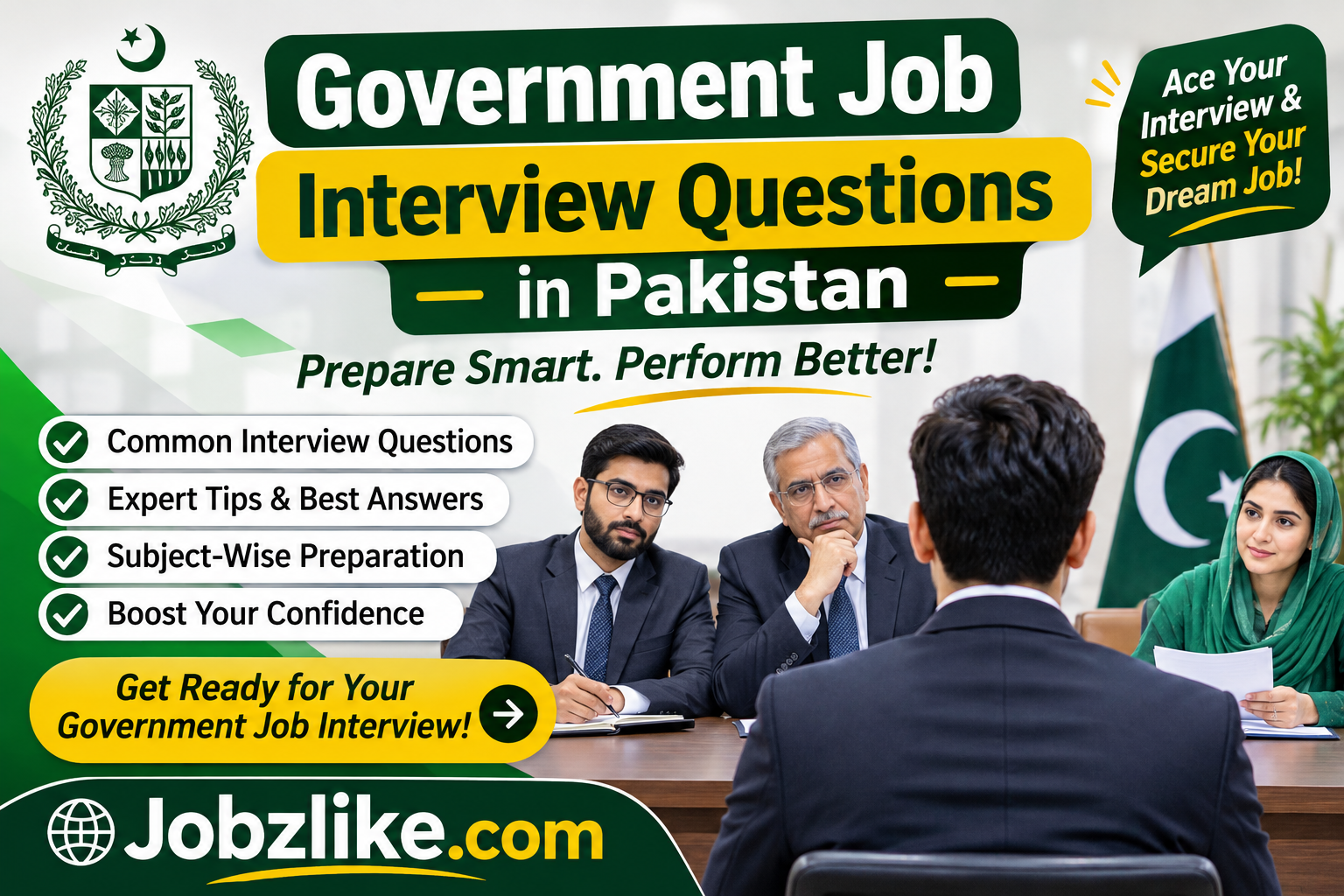
Government jobs in Pakistan are considered attractive career opportunities because they offer professional stability, structured salary packages, career development, retirement benefits, and opportunities to serve the country. Every year, thousands of candidates apply for government vacancies announced by federal and provincial departments, public-sector organizations, educational institutions, law enforcement agencies, and administrative authorities. However, passing a written examination or meeting the eligibility criteria does not guarantee final selection. Candidates must also perform well in the interview, where the selection committee evaluates their knowledge, confidence, communication skills, personality, professional attitude, and suitability for the advertised position. Government job interview questions in Pakistan usually cover personal introductions, educational backgrounds, relevant experience, general knowledge, Pakistan affairs, current affairs, subject-related topics, departmental responsibilities, and basic professional ethics.
Some interview panels also ask unexpected questions to examine how candidates respond under pressure and handle unfamiliar situations. Proper preparation can help applicants communicate their abilities effectively and create a positive impression. Whether you are preparing for an FPSC, PPSC, SPSC, KPPSC, BPSC, departmental, teaching, banking, or other public-sector interview, understanding the interview process is essential. This guide explains important interview questions, preparation strategies, professional behaviour, common mistakes, and practical techniques to help candidates improve their performance and increase their chances of securing a government position.
Understanding the Government Job Interview Process in Pakistan
Government job interviews are generally conducted to assess whether applicants possess the qualifications, knowledge, skills, and personality required for a particular position.
The interview process may differ depending on the recruiting authority, department, job scale, and nature of the vacancy.
Candidates may face an individual interview, a panel interview, a technical assessment, or a combination of different evaluation methods.
Important elements of the government recruitment interview process include:
-
Verification of educational qualifications and personal information.
-
Questions about academic subjects and professional expertise.
-
Assessment of communication and presentation skills.
-
Evaluation of general knowledge and current affairs.
-
Questions about the department and its responsibilities.
-
Assessment of confidence, honesty, and decision-making abilities.
-
Discussion of previous employment and relevant experience.
-
Evaluation of professional behaviour and public-service motivation.
-
Verification of documents and eligibility requirements where applicable.
For positions advertised through FPSC and provincial public service commissions, candidates should carefully review the relevant recruitment notice and interview instructions.
Important Personal Introduction Questions Asked by Interview Panels
Personal introduction questions are often among the first questions asked during a government job interview. These questions help interviewers understand the candidate’s background, educational journey, interests, achievements, and career objectives.
Candidates should prepare short, natural, and informative answers rather than memorizing lengthy introductions.
Common personal interview questions include:
-
Tell us about yourself.
-
What is your full name and educational background?
-
Where do you belong?
-
What are your major academic achievements?
-
Why did you choose your particular field of study?
-
What are your professional strengths?
-
What is your biggest weakness?
-
Why do you want to join government service?
-
What are your future career goals?
-
How would your teachers or previous employers describe you?
-
What motivates you to work in the public sector?
-
Why should we select you for this position?
A good introduction should include your name, qualification, relevant skills, experience, and interest in the advertised position.
Avoid sharing unnecessary family details unless the panel specifically asks about them.
Government Job Interview Questions According to Job Categories
Different government positions require different knowledge and professional abilities. Therefore, candidates should prepare according to the responsibilities mentioned in the official job advertisement.
| Government Job Category | Important Interview Topics | Common Questions |
|---|---|---|
| Administrative Jobs | Office management, administration, governance | What are the responsibilities of an administrator? |
| Teaching Jobs | Subject knowledge, teaching methods, classroom management | How do you manage a difficult student? |
| Police Jobs | Law enforcement, discipline, public safety | What qualities make a good police officer? |
| Clerical Jobs | Computer skills, office procedures, documentation | What is the role of an office assistant? |
| Banking Jobs | Financial knowledge, customer service, banking regulations | What is the difference between saving and current accounts? |
| Engineering Jobs | Technical concepts, project management, safety | Explain the main responsibilities of an engineer. |
| Medical Jobs | Healthcare services, patient management, medical ethics | How do you handle an emergency patient? |
| IT Jobs | Networking, programming, cybersecurity, databases | What is the difference between hardware and software? |
Candidates should not prepare only general questions. Technical and position-specific knowledge can be especially important when applying for specialized government vacancies.
Pakistan Affairs and General Knowledge Topics for Interview Preparation
Pakistan Affairs and general knowledge are important preparation areas for many government recruitment interviews. Interview panels may ask questions about national history, constitutional development, geography, political institutions, economic conditions, and important national events.
Candidates should revise the following topics:
-
Creation of Pakistan and the Pakistan Movement.
-
Important personalities of the independence movement.
-
Historical background of the Two-Nation Theory.
-
Objectives Resolution and its constitutional importance.
-
Major constitutional developments in Pakistan.
-
Important features of the Constitution of 1973.
-
Federal and provincial government structures.
-
National symbols and geographical boundaries.
-
Important rivers, dams, mountains, and provinces.
-
Major economic sectors of Pakistan.
-
Relations with neighbouring countries.
-
Important national institutions.
-
Major developments in education, healthcare, and infrastructure.
Candidates should also understand the difference between federal, provincial, and local government responsibilities.
For current information, regularly consult reliable news sources and official government publications.
Current Affairs Questions That Candidates Should Never Ignore
Current affairs preparation helps candidates demonstrate awareness of national and international developments. Government employees are expected to understand important issues affecting society, public administration, national security, and economic development.
Important current affairs preparation areas include:
-
Pakistan’s economic situation and development priorities.
-
Inflation, unemployment, and taxation.
-
International relations and diplomatic developments.
-
Major regional and global conflicts.
-
Climate change and environmental protection.
-
Energy production and electricity challenges.
-
Education and healthcare reforms.
-
Digital transformation and artificial intelligence.
-
International organizations and their functions.
-
Important national and international agreements.
-
Government policies and public welfare initiatives.
-
Major developments reported in recent news.
Candidates should avoid relying on outdated current affairs books. Information about officeholders, economic indicators, policies, and recent events should be checked shortly before the interview.
Essential Documents Required Before Attending a Government Interview
Document preparation is an important part of the recruitment process. Candidates should carefully read their interview call letter because document requirements may vary between departments and recruiting authorities.
| Document | Purpose | Preparation Advice |
|---|---|---|
| Original CNIC | Identity verification | Check validity and carry it safely |
| Educational Certificates | Academic qualification verification | Arrange certificates chronologically |
| Degree and Transcripts | Verification of academic achievements | Carry original documents and required copies |
| Domicile Certificate | Verification of regional eligibility | Check the details and issuing authority |
| Experience Certificate | Professional experience verification | Arrange certificates from previous employers |
| Updated CV | Summary of education and experience | Ensure all information is accurate |
| Recent Photographs | Identification and official records | Follow the requested photograph specifications |
| Interview Call Letter | Interview identification and instructions | Print or save a clear copy |
| NOC, If Required | Permission for eligible serving employees | Obtain it according to departmental rules |
| Professional Registration | Verification of specialized qualifications | Carry relevant registration documents |
Keep all documents in a clean folder. Do not submit original documents unless the authorized officials request them for verification.
Professional Behaviour and Body Language During an Interview
Your behaviour can influence how the interview panel evaluates your suitability for a government position. Even candidates with excellent academic qualifications should maintain professional manners throughout the interview.
Follow these practical guidelines:
-
Arrive at the interview venue before the reporting time.
-
Wear clean, formal, and appropriate clothing.
-
Greet the panel respectfully when entering the room.
-
Ask permission before sitting down.
-
Maintain natural eye contact with interviewers.
-
Sit comfortably without unnecessary movement.
-
Listen carefully before answering questions.
-
Speak clearly and maintain a suitable volume.
-
Avoid interrupting the interview panel.
-
Do not argue aggressively when you disagree.
-
Maintain a positive and professional attitude.
-
Thank the panel before leaving the interview room.
Good body language reflects confidence, self-control, and professional maturity.
Avoid exaggerated gestures, unnecessary facial expressions, and overconfidence.
Comparison Between Successful and Unsuccessful Interview Approaches
Interview performance depends on preparation, communication, professional behaviour, and the ability to answer questions appropriately.
The following comparison explains common differences between effective and ineffective interview approaches.
| Successful Candidate Approach | Unsuccessful Candidate Approach |
|---|---|
| Researches the department before attending | Knows very little about the department |
| Gives clear and relevant answers | Provides lengthy and confusing responses |
| Maintains professional body language | Displays nervous or careless behaviour |
| Admits when an answer is unknown | Gives incorrect information confidently |
| Understands the advertised job description | Has no knowledge of job responsibilities |
| Arrives before the scheduled time | Reaches the venue late |
| Provides honest information | Exaggerates qualifications or experience |
| Maintains respectful communication | Interrupts or argues with interviewers |
| Revises current affairs | Ignores recent developments |
| Carries organized documents | Arrives with incomplete paperwork |
The main objective should be to demonstrate genuine ability rather than attempting to impress the panel through unrealistic claims.
Subject-Related Technical Questions for Government Recruitment
Technical questions are particularly important for candidates applying for professional, scientific, educational, engineering, medical, accounting, and information technology positions.
Candidates should revise the core concepts of their academic discipline and understand how those concepts apply to the advertised job.
Examples of technical interview questions include:
-
What are the fundamental principles of your subject?
-
Explain an important concept related to your degree.
-
What practical skills have you developed during your education?
-
How does your academic knowledge relate to this position?
-
Which tools, methods, or technologies are commonly used in your profession?
-
What are the latest developments in your field?
-
How would you solve a technical problem?
-
Explain a project or research assignment you completed.
-
What professional challenges do you expect in this position?
-
How would you improve the quality of work in your department?
For teaching positions, revise lesson planning, assessment techniques, curriculum development, and classroom management.
For engineering positions, focus on technical standards, calculations, safety procedures, and practical applications.
For administrative positions, study office management, record keeping, communication, and public administration.
Common Questions About Government Departments and Their Responsibilities
Before attending an interview, candidates should understand the department in which they are applying. Department-related questions help interviewers determine whether applicants have researched the organization and understand the purpose of their prospective position.
Prepare answers to questions such as:
-
What do you know about this department?
-
When was this department established?
-
What are its major responsibilities?
-
Who is the administrative head of the department?
-
Which ministry or authority supervises it?
-
What public services does the department provide?
-
What challenges does the organization face?
-
How does this department contribute to national development?
-
What improvements would you suggest?
-
Why are you interested in joining this organization?
Candidates should use the official departmental website to verify organizational information.
They should also understand the difference between the department’s overall responsibilities and the specific duties of the advertised position.
Salary, Job Scale, Benefits, and Career Growth Questions
Government job applicants should understand the employment structure associated with their advertised position. Interviewers may ask whether candidates know the basic requirements and professional responsibilities of the job.
| Interview Topic | What Candidates Should Understand |
|---|---|
| Basic Pay Scale | The advertised BPS or applicable employment grade |
| Salary Structure | Basic pay and applicable allowances |
| Job Responsibilities | Daily duties and assigned responsibilities |
| Working Hours | Official working schedule and departmental requirements |
| Promotion | Applicable promotion policies and eligibility |
| Transfer Policy | Relevant posting and transfer conditions |
| Retirement Benefits | Applicable pension or contributory arrangements |
| Leave Policy | Official leave rules and eligibility |
| Training | Professional development and departmental training |
| Probation | Applicable probation conditions and duration |
A useful interview question is: Why are you interested in this particular government position?
A strong answer should focus on professional development, public service, relevant qualifications, and the opportunity to contribute to the organization.
Do not make salary the only reason for joining government service.
Also remember that pay, allowances, pension arrangements, and employment conditions depend on the applicable rules and the specific appointment.
How to Answer Difficult and Unexpected Interview Questions
Sometimes interviewers ask unfamiliar questions to evaluate a candidate’s thinking ability, honesty, and response under pressure.
These questions do not always require complicated answers. The panel may simply want to understand how you approach unfamiliar situations.
Use the following strategies:
-
Listen carefully and understand the complete question.
-
Take a short pause before responding.
-
Identify the main issue being discussed.
-
Connect your answer with relevant knowledge.
-
Explain your reasoning in simple language.
-
Avoid making assumptions without sufficient information.
-
Ask for clarification if the question is unclear.
-
Admit honestly when you do not know the answer.
-
Avoid unnecessary arguments or defensive behaviour.
-
Remain calm even when the question is challenging.
For example, if an interviewer asks about an unfamiliar government policy, you can explain the related concept you understand and honestly acknowledge the specific information you cannot recall.
Never invent statistics, legal provisions, or official facts simply to avoid admitting that you do not know something.
Interview Preparation Mistakes That Can Reduce Selection Chances
Many candidates lose valuable opportunities because they overlook simple preparation requirements. Avoiding these mistakes can improve your overall interview performance.
Common mistakes include:
-
Preparing only personal introduction questions.
-
Ignoring the job description and eligibility requirements.
-
Not researching the recruiting department.
-
Memorizing answers without understanding their meaning.
-
Using outdated general knowledge.
-
Giving answers unrelated to the question.
-
Speaking too quickly because of nervousness.
-
Displaying overconfidence or unnecessary attitude.
-
Criticizing previous employers or educational institutions.
-
Providing inaccurate information about qualifications.
-
Ignoring the importance of formal appearance.
-
Arriving without the required documents.
-
Failing to practise speaking before the interview.
-
Giving unsupported answers about current affairs.
The best preparation strategy combines subject knowledge, practical understanding, communication practice, and professional behaviour.
Effective Preparation Plan for Government Job Interviews
A structured preparation schedule can help candidates cover important interview topics without wasting time.
The following preparation plan can be adjusted according to the interview date and job category.
| Preparation Period | Main Activities | Expected Outcome |
|---|---|---|
| First Day | Study the advertisement and job description | Understand position requirements |
| Second Day | Revise personal introduction and academic background | Improve introductory answers |
| Third Day | Study department history and responsibilities | Develop organizational awareness |
| Fourth Day | Revise subject-related knowledge | Strengthen technical preparation |
| Fifth Day | Study Pakistan Affairs and general knowledge | Improve national awareness |
| Sixth Day | Review current affairs and important developments | Improve awareness of recent events |
| Seventh Day | Conduct a mock interview and check documents | Improve confidence and readiness |
Candidates with more preparation time should expand this schedule and revise each topic regularly.
Practising with a friend, teacher, or experienced professional can also help identify weaknesses.
Communication Skills Required to Impress a Government Interview Panel
Communication skills are essential because government employees regularly interact with colleagues, supervisors, citizens, and other institutions.
Candidates should demonstrate the ability to explain ideas clearly, listen carefully, and communicate respectfully.
Important communication skills include:
-
Speaking fluent and understandable language.
-
Organizing answers logically.
-
Using appropriate professional vocabulary.
-
Listening without interrupting.
-
Explaining technical information simply.
-
Maintaining a balanced speaking speed.
-
Answering directly without unnecessary details.
-
Asking relevant questions when clarification is needed.
-
Demonstrating confidence without arrogance.
-
Communicating respectfully with people from different backgrounds.
In Pakistan, candidates may be interviewed in English, Urdu, or another language depending on the department and interview requirements.
Practise the language most relevant to your position while maintaining the ability to communicate professionally.
Points to Remember When Preparing for Different Interview Stages
Government recruitment may involve several stages, depending on the hiring authority and the nature of the vacancy.
Candidates should understand the purpose of each stage and prepare accordingly.
-
Written Examination: Revise the prescribed syllabus, subject knowledge, and relevant general information.
-
Initial Screening: Understand the eligibility criteria and recruitment requirements.
-
Document Verification: Organize original certificates and supporting documents.
-
Psychological Assessment: Follow the instructions and respond honestly.
-
Technical Interview: Prepare specialized knowledge and practical concepts.
-
Final Interview: Demonstrate confidence, suitability, and professional communication.
-
Medical Examination: Follow the applicable medical assessment requirements.
-
Final Merit Process: Understand that selection depends on the relevant recruitment rules and overall evaluation.
Not every government vacancy includes all these stages. Candidates should follow the official recruitment advertisement and instructions issued by the relevant authority.
Tips for Fresh Graduates Appearing in Their First Government Interview
Fresh graduates may feel nervous because they have limited professional experience. However, a lack of employment history does not mean they cannot perform well.
Interview panels may evaluate academic knowledge, learning ability, communication skills, and potential for professional development.
Fresh candidates should follow these recommendations:
-
Revise important concepts from their degree.
-
Prepare a confident personal introduction.
-
Discuss academic projects and research assignments.
-
Explain internships and volunteer activities where relevant.
-
Identify skills developed during university education.
-
Understand the responsibilities of the advertised position.
-
Research the department and its public services.
-
Prepare examples of teamwork and problem-solving.
-
Demonstrate willingness to learn new skills.
-
Avoid pretending to have professional experience.
-
Explain how academic knowledge can support job responsibilities.
Fresh graduates should focus on their genuine abilities and demonstrate that they are ready to learn and work responsibly.
Important Interview Questions and Their Recommended Answer Approaches
Practising common interview questions helps candidates prepare structured responses. The following table provides examples and guidance rather than fixed answers.
| Interview Question | Recommended Answer Approach |
|---|---|
| Tell us about yourself. | Introduce your education, skills, and career interests. |
| Why do you want a government job? | Explain your interest in public service and professional development. |
| Why should we hire you? | Connect your qualifications and skills with job requirements. |
| What are your strengths? | Mention relevant strengths supported by examples. |
| What is your weakness? | Identify a genuine weakness and explain how you are improving. |
| How do you handle pressure? | Describe a practical approach to prioritizing responsibilities. |
| What do you know about our department? | Explain its major functions and public responsibilities. |
| Where do you see yourself in five years? | Discuss professional growth and improved performance. |
| What if you disagree with your supervisor? | Explain respectful communication and adherence to official procedures. |
| What will you do if you make a mistake? | Explain accountability, correction, and prevention. |
Candidates should personalize their answers according to their education, experience, and the advertised position.
Public Service Ethics and Responsibilities Asked During Interviews
Government employees have responsibilities that extend beyond completing routine office tasks. They are expected to follow applicable laws, maintain professional standards, and provide services fairly.
Interview panels may ask ethical questions to assess the candidate’s understanding of integrity and accountability.
Important topics include:
-
Honesty and professional integrity.
-
Transparency in official work.
-
Respect for citizens and colleagues.
-
Confidentiality of government information.
-
Responsible use of public resources.
-
Compliance with applicable laws and regulations.
-
Prevention of corruption and misconduct.
-
Equal treatment of citizens.
-
Accountability for professional decisions.
-
Avoidance of conflicts of interest.
-
Maintaining discipline and punctuality.
-
Providing services without discrimination.
For example, if an interviewer asks what you would do if someone offered you money to perform an illegal favour, explain that you would refuse the offer and follow the applicable reporting procedures.
Your answers should demonstrate a commitment to lawful, impartial, and responsible public service.
How to Build Confidence Before the Final Interview
Confidence is developed through preparation, practice, and a clear understanding of your professional strengths. Candidates who prepare systematically are generally better equipped to manage interview pressure.
Follow these practical steps:
-
Practise your introduction every day.
-
Prepare answers to frequently asked questions.
-
Conduct mock interviews with realistic questions.
-
Revise important academic and technical concepts.
-
Read reliable newspapers and current affairs reports.
-
Research the department’s official website.
-
Prepare your clothes and documents in advance.
-
Reach the interview location early.
-
Maintain a positive mindset.
-
Get sufficient rest before the interview.
-
Avoid last-minute memorization of unfamiliar topics.
-
Focus on answering honestly and confidently.
Remember that confidence does not mean knowing every answer. It means communicating your knowledge effectively and responding professionally when faced with difficult questions.
Conclusion: Prepare Smartly for Government Job Interviews in Pakistan
Government job interviews in Pakistan provide candidates with an opportunity to demonstrate their educational qualifications, professional abilities, general awareness, communication skills, and suitability for public service. Success requires more than memorizing a list of common questions. Applicants should understand the advertised position, research the relevant department, revise academic subjects, study Pakistan Affairs, follow current developments, and prepare for technical and personal questions. Professional behaviour, punctuality, honesty, confidence, and organized documentation also contribute to a positive interview experience.
Candidates should practise answering questions naturally rather than memorizing lengthy responses that may sound artificial. If an unfamiliar question arises, remain calm, explain what you understand, and acknowledge information you cannot recall instead of providing misleading answers. Fresh graduates should highlight their academic achievements, practical skills, and willingness to learn, while experienced applicants should connect their previous responsibilities with the requirements of the new position. Whether applying through FPSC, PPSC, SPSC, KPPSC, BPSC, or a departmental recruitment process, always follow the official interview instructions. Consistent preparation and a professional attitude can help you perform confidently and improve your prospects of securing a suitable government job in Pakistan.