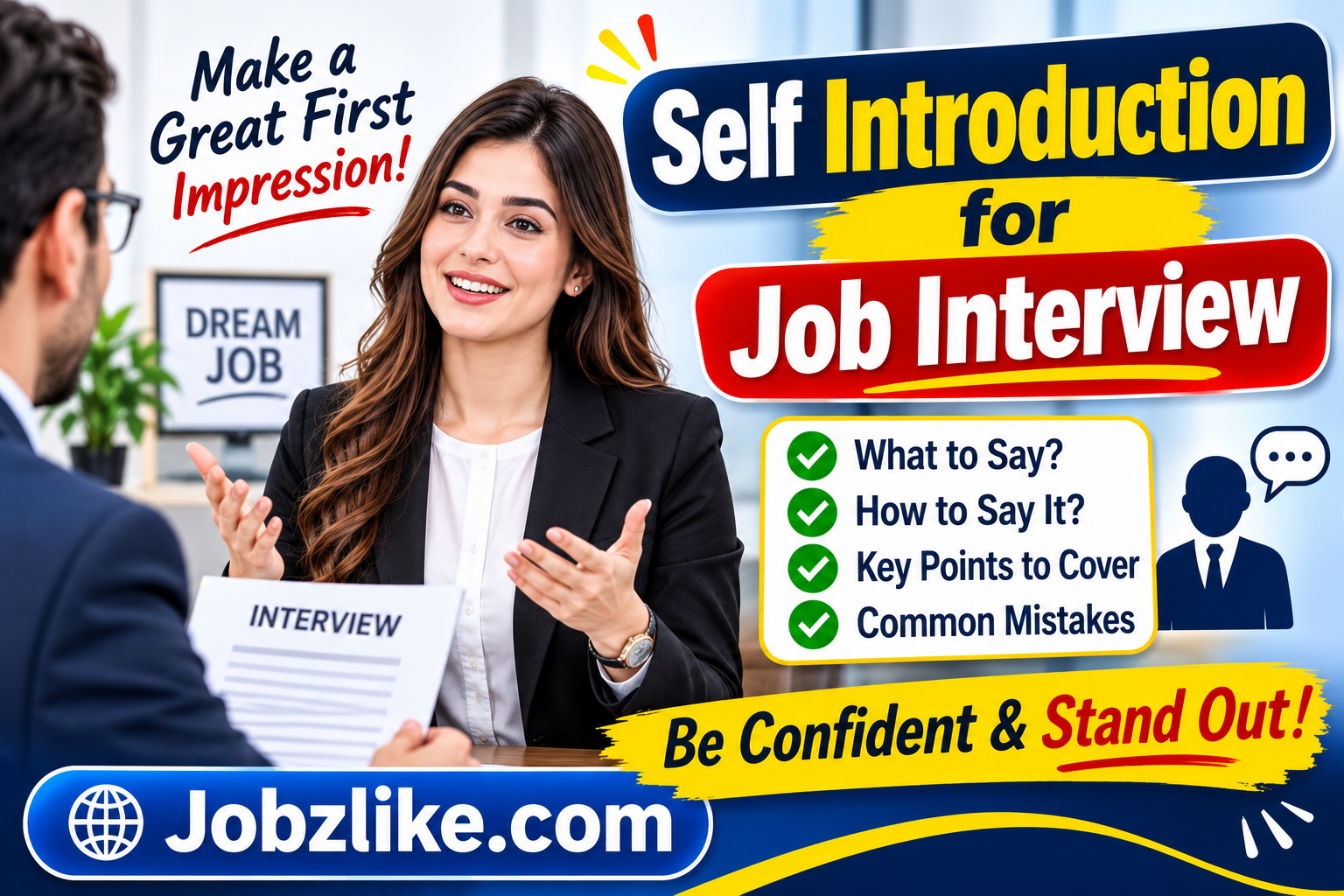
A self introduction for a job interview is one of the most important parts of the recruitment and selection process. It is usually the first opportunity for candidates to introduce themselves to an employer, explain their professional background, highlight their qualifications, and demonstrate why they are suitable for a particular position. A strong introduction creates a positive first impression and helps interviewers understand the candidate’s personality, communication skills, education, professional experience, and career goals. Whether you are applying for a government job, private-sector position, banking vacancy, teaching opportunity, IT role, or entry-level position, preparing an effective introduction can improve your interview performance.
Many candidates feel nervous when interviewers ask, “Tell me about yourself.” However, this question is an opportunity to present your strongest professional qualities in a clear and confident manner. Your answer should be relevant to the advertised position rather than a complete description of your personal life. It should include your name, educational background, professional experience, important skills, achievements, and future career objectives. Fresh graduates can discuss their academic qualifications, internships, projects, and transferable skills, while experienced professionals can emphasize their previous responsibilities and accomplishments.
Preparing before an interview is equally important. Candidates should research the organization, understand the job description, practice their answers, select professional clothing, and arrive on time. This guide explains how to prepare a self introduction for a job interview, organize your thoughts, communicate effectively, follow interview rules, and make a memorable impression on recruiters. It also provides practical examples, useful tips, comparison tables, and preparation strategies for freshers and experienced candidates.
Essential Details to Include in Your Professional Introduction
A professional introduction should provide enough information to help the interviewer understand your suitability without making your answer unnecessarily lengthy.
Include these important details:
- Full name: Begin by introducing yourself with your name.
- Educational background: Mention your highest qualification, degree, diploma, or relevant academic achievement.
- Professional experience: Explain your previous employment, internship, or practical training.
- Key skills: Highlight abilities related to the advertised position.
- Professional achievements: Mention important projects, awards, certifications, or measurable results.
- Career interests: Explain the professional area in which you want to develop.
- Job suitability: Connect your qualifications and experience with the employer’s requirements.
- Career objectives: Briefly describe your professional ambitions.
Avoid sharing unnecessary personal information that does not contribute to your professional introduction.
How to Start Your Answer When an Interviewer Says Tell Me About Yourself
The opening sentence of your introduction should sound natural, polite, and confident. Avoid memorized statements that make your answer sound artificial.
You can begin with these examples:
- “Good morning. Thank you for giving me this opportunity to introduce myself.”
- “My name is [Your Name], and I have completed my education in [Your Field].”
- “I am a motivated professional with experience in [Your Industry].”
- “I recently graduated with a degree in [Subject], and I am interested in developing my career in this field.”
- “I have professional experience in [Department or Industry], where I developed strong skills in [Relevant Skills].”
Your opening should match your experience level and the type of job you are applying for. Speak clearly, maintain a comfortable pace, and move naturally toward your educational and professional background.
Recommended Structure for a Successful Job Interview Introduction
Following a proper structure helps candidates organize their thoughts and avoid forgetting important information during an interview.
| Introduction Stage | Information to Include | Recommended Approach |
|---|---|---|
| Greeting | Professional greeting | Start politely |
| Personal introduction | Your name | Speak clearly |
| Education | Degree and qualification | Mention relevant education |
| Experience | Previous employment or internship | Highlight responsibilities |
| Skills | Technical and soft skills | Select job-related abilities |
| Achievements | Projects and accomplishments | Provide practical examples |
| Career goals | Future professional plans | Connect them with the vacancy |
| Closing | Interest in the position | End confidently |
A well-organized introduction usually takes between 45 seconds and two minutes, depending on the position, interview format, and employer’s expectations.
Self Introduction for Fresh Graduates Applying for Their First Job
Fresh graduates often worry because they have limited professional experience. However, employers do not expect every entry-level applicant to have an extensive employment history.
Fresh candidates can focus on:
- Academic qualifications and relevant subjects.
- University assignments and final-year projects.
- Internships and volunteer activities.
- Computer literacy and technical knowledge.
- Communication and teamwork abilities.
- Leadership responsibilities in educational activities.
- Professional certifications and online courses.
- Willingness to learn new skills.
- Interest in the employer’s industry.
- Long-term career development goals.
Example for fresh graduates:
“Good morning. My name is [Your Name]. I recently completed my bachelor’s degree in [Subject] from [University Name]. During my academic career, I developed knowledge of [Relevant Subjects] and worked on projects that improved my research, communication, and problem-solving skills. I am a hardworking and responsible individual who enjoys learning new things. I am interested in this opportunity because it matches my educational background and career interests. I look forward to applying my knowledge, developing practical experience, and contributing positively to your organization.”
Creating an Impressive Introduction for Experienced Job Applicants
Experienced professionals should use their introduction to demonstrate their career progression, industry knowledge, and ability to handle professional responsibilities.
Important points to discuss include:
- Total years of professional experience.
- Previous companies or relevant industries.
- Current or most recent job position.
- Major responsibilities and daily duties.
- Technical knowledge and professional certifications.
- Important projects completed successfully.
- Leadership and management experience.
- Achievements supported by measurable results.
- Reasons for seeking a new professional opportunity.
- Skills that match the advertised vacancy.
For example, an experienced accountant can mention financial reporting, budgeting, taxation, bookkeeping, and accounting software. An IT professional can discuss programming languages, software development, cybersecurity, database management, or technical support.
Avoid explaining every previous job in detail. Select the experiences that demonstrate your suitability for the position.
Job Interview Preparation Checklist for Better Performance
Good preparation helps candidates control nervousness and communicate their qualifications effectively.
- Read the complete job advertisement.
- Understand the position’s responsibilities.
- Research the company’s background and services.
- Review your CV and application information.
- Prepare a short professional introduction.
- Practice common interview questions.
- Prepare examples of your previous achievements.
- Research the expected salary range.
- Organize educational certificates and experience letters.
- Select appropriate professional clothing.
- Check the interview venue or online meeting link.
- Plan to arrive approximately 10–15 minutes early.
- Keep a copy of your updated CV.
- Prepare thoughtful questions for the interviewer.
Completing this checklist before the interview can prevent avoidable mistakes and improve your confidence.
Difference Between Strong and Weak Self Introductions
The quality of your introduction depends on how effectively you communicate relevant information. A good introduction is organized, professional, and focused on the employer’s requirements.
| Weak Introduction | Strong Introduction |
|---|---|
| Includes unnecessary personal stories | Focuses on professional information |
| Uses unclear sentences | Uses simple and understandable language |
| Repeats information without purpose | Highlights relevant qualifications |
| Shows little preparation | Demonstrates knowledge of the vacancy |
| Uses exaggerated claims | Provides honest achievements |
| Sounds completely memorized | Sounds natural and confident |
| Does not mention job suitability | Connects skills with job requirements |
| Takes too much time | Communicates important points briefly |
A strong introduction does not require complicated English or impressive vocabulary. Clear communication, relevant information, and professional behavior are more important.
Important Communication Skills to Demonstrate During an Interview
Communication skills influence how employers evaluate candidates. Even highly qualified applicants may struggle if they cannot explain their knowledge effectively.
Develop these communication habits:
- Speak in a clear and understandable voice.
- Maintain a natural speaking speed.
- Listen carefully before answering questions.
- Avoid interrupting the interviewer.
- Use professional and respectful language.
- Maintain appropriate eye contact.
- Organize your answers before speaking.
- Avoid unnecessary technical terminology.
- Ask for clarification when a question is unclear.
- Demonstrate a positive and professional attitude.
Candidates who are not fluent in English should not lose confidence. They should communicate honestly and clearly in the language accepted by the employer.
Professional Body Language That Creates a Positive First Impression
Body language communicates confidence, attentiveness, and professionalism. Interviewers often notice a candidate’s posture, facial expressions, eye contact, and gestures.
Follow these practical suggestions:
- Sit comfortably with an upright posture.
- Greet the interviewer politely.
- Offer a natural and professional smile.
- Maintain comfortable eye contact.
- Keep your hands relaxed.
- Avoid unnecessary movements.
- Do not continuously check your mobile phone.
- Show attention when the interviewer speaks.
- Avoid crossing your arms in a defensive manner.
- Remain calm when answering difficult questions.
Body language should look natural rather than forced. Your gestures should support your spoken answers.
Common Interview Questions and the Best Way to Answer Them
Preparing common questions helps applicants avoid confusion during the recruitment process.
| Interview Question | What the Employer Wants to Know | Suggested Answer Direction |
|---|---|---|
| Tell me about yourself | Background and suitability | Education, experience, and skills |
| Why should we hire you? | Your professional value | Relevant abilities and achievements |
| What are your strengths? | Personal capabilities | Mention job-related strengths |
| What is your weakness? | Self-awareness | Discuss an improvement area |
| Why do you want this job? | Motivation | Explain career and organizational fit |
| Where do you see yourself in five years? | Career planning | Describe realistic professional growth |
| Why did you leave your previous job? | Employment motivation | Give an honest and professional explanation |
| What are your salary expectations? | Compensation expectations | Provide a researched and reasonable range |
Keep your answers relevant and avoid criticizing previous employers or colleagues.
How to Introduce Yourself in Government Job Interviews in Pakistan
Government job interviews in Pakistan may involve questions about educational qualifications, professional knowledge, general awareness, relevant experience, and the responsibilities of the advertised position.
Candidates applying through public service commissions, government departments, educational institutions, and other public organizations should prepare carefully.
- Start with a respectful greeting.
- Mention your academic qualifications.
- Explain your subject specialization.
- Discuss relevant work experience.
- Demonstrate knowledge of the department.
- Prepare for questions about the advertised position.
- Review relevant national and current affairs topics.
- Understand the responsibilities of the government post.
- Carry original documents and required photocopies.
- Answer questions honestly and respectfully.
Candidates appearing before a selection board should remain patient and composed. Follow the instructions provided in the interview call letter and avoid assuming that every government department follows an identical interview procedure.
Mistakes That Can Reduce Your Chances of Interview Success
Even qualified candidates can create a negative impression through poor preparation or unprofessional behavior.
Avoid these common mistakes:
- Giving an introduction that is too long.
- Memorizing answers without understanding them.
- Providing false information about qualifications.
- Speaking negatively about former employers.
- Arriving late without a reasonable explanation.
- Wearing inappropriate clothing.
- Interrupting the interviewer.
- Using slang or unprofessional language.
- Showing overconfidence or arrogance.
- Giving unrelated answers.
- Failing to research the company.
- Checking your phone during the interview.
- Claiming skills that you cannot demonstrate.
- Showing no interest in the position.
Learning from these mistakes can help you present yourself more professionally.
Planning Your Introduction According to Different Job Categories
Every profession has different requirements. Your introduction should emphasize the skills and experience most relevant to the position.
| Job Category | Important Introduction Points | Relevant Skills |
|---|---|---|
| Teaching | Education, teaching practice, subject knowledge | Communication and classroom management |
| Banking | Finance education, customer service, accounting | Accuracy and analytical thinking |
| IT | Technical qualifications and projects | Programming and problem-solving |
| Administration | Office experience and coordination | Organization and documentation |
| Sales | Sales experience and customer relationships | Negotiation and persuasion |
| Healthcare | Professional qualifications and clinical training | Patient care and teamwork |
| Engineering | Engineering degree and practical projects | Technical analysis and design |
| Customer Support | Communication and service experience | Listening and conflict resolution |
Before preparing your introduction, study the vacancy requirements and select the most relevant professional details.
Practical Tips for Overcoming Interview Nervousness
Feeling nervous before an interview is normal, particularly when applying for your first job or attending a competitive selection process.
Use these methods to improve your confidence:
- Practice your introduction in front of a mirror.
- Record your voice and review your speaking style.
- Conduct mock interviews with friends or family members.
- Prepare your documents in advance.
- Research the organization to reduce uncertainty.
- Take slow, comfortable breaths before entering the interview room.
- Wear clothes that are professional and comfortable.
- Focus on communicating your abilities instead of trying to impress everyone.
- Avoid comparing yourself with other candidates.
- Get sufficient sleep before the interview.
- Reach the venue early.
- Remind yourself that an interview is a professional conversation.
Confidence develops through preparation and practice. You do not need to eliminate every nervous feeling to perform well.
Step-by-Step Method to Prepare a Memorable Introduction
Preparing an introduction becomes easier when you divide the process into manageable stages.
- Understand the vacancy: Identify the qualifications, skills, and experience required by the employer.
- Review your background: Select the most relevant educational and professional information.
- Choose your strongest points: Identify two or three skills or achievements that support your application.
- Create an opening statement: Prepare a polite greeting and introduce yourself.
- Organize your information: Arrange your education, experience, skills, and career goals logically.
- Connect your background with the job: Explain how your abilities match the advertised position.
- Prepare a closing sentence: End by expressing your interest in the opportunity.
- Practice speaking: Rehearse until your introduction sounds natural.
- Check the duration: Keep your answer concise and relevant.
- Improve your delivery: Work on pronunciation, posture, and confidence.
This method can help both fresh graduates and experienced applicants prepare an introduction that communicates their professional value.
Useful English Sentences for a Job Interview Introduction
Candidates who find it difficult to start speaking can practice professional sentences before attending an interview.
- “Thank you for providing me with this opportunity.”
- “I have completed my education in…”
- “My academic background is in…”
- “I have experience working in…”
- “My professional strengths include…”
- “I am particularly interested in this position because…”
- “During my previous employment, I was responsible for…”
- “I enjoy working in a team and solving problems.”
- “I am willing to learn and improve my professional skills.”
- “My long-term goal is to develop my career in this industry.”
- “I believe my qualifications are relevant to this position.”
- “I would be pleased to contribute to your organization.”
Practice using these sentences in your own words instead of repeating them mechanically.
Interview Etiquette and Professional Rules Every Candidate Should Follow
Interview etiquette refers to the professional behavior expected from applicants throughout the recruitment process.
- Arrive according to the scheduled interview time.
- Follow the organization’s entry and registration procedures.
- Greet interviewers respectfully.
- Wait for permission before taking your seat when appropriate.
- Keep your mobile phone silent.
- Maintain professional language.
- Listen carefully to every question.
- Avoid arguing with the interview panel.
- Do not interrupt other candidates.
- Provide truthful information.
- Respect confidentiality.
- Thank the interviewer before leaving.
- Follow the employer’s instructions regarding further communication.
Professional manners demonstrate that you understand workplace expectations and can behave responsibly in an organizational environment.
Sample Self Introduction for Different Experience Levels
A practical introduction example can help candidates understand how to organize their own answers.
| Candidate Type | Sample Introduction Focus |
|---|---|
| Fresh graduate | “I recently completed my degree in [Subject] and developed strong academic knowledge, communication skills, and an interest in this profession.” |
| Experienced employee | “I have [Number] years of experience in [Industry], with expertise in [Skills] and practical knowledge of daily professional operations.” |
| Career changer | “My previous experience in [Field] helped me develop transferable skills, and I am now interested in applying these abilities in [New Field].” |
| Internship applicant | “I am currently studying [Subject] and want to gain practical experience through an internship related to my academic background.” |
| Administrative applicant | “I have knowledge of office administration, documentation, scheduling, and communication, which I believe matches this position.” |
| Teaching applicant | “My educational background is in [Subject], and I am interested in supporting students through effective teaching and classroom management.” |
Personalize every example with accurate information from your own academic and professional background.
Preparing for Online and Virtual Job Interviews
Online interviews are increasingly common in private companies, multinational organizations, remote employment, and international recruitment.
Candidates should prepare their equipment and interview environment before the scheduled meeting.
- Check your internet connection.
- Test your microphone and camera.
- Charge your laptop or mobile device.
- Use a quiet room with minimal interruptions.
- Choose a clean and professional background.
- Position your camera at eye level.
- Wear appropriate interview clothing.
- Keep your CV and notes accessible.
- Join the meeting a few minutes early.
- Keep your microphone muted when you are not speaking.
- Look toward the camera while delivering important answers.
- Avoid opening unrelated applications during the interview.
A professional online environment shows that you can handle modern workplace communication and remote collaboration.
Documents and Personal Information to Prepare Before an Interview
Having the required documents ready can make the interview process more organized. Requirements differ between employers, departments, and job categories.
| Document | Purpose | Preparation Advice |
|---|---|---|
| Updated CV or resume | Presents your professional background | Check contact details and experience |
| CNIC | Identity verification in Pakistan | Carry the original if requested |
| Educational certificates | Confirms academic qualifications | Arrange copies and originals |
| Degree or transcript | Provides academic details | Verify that documents are complete |
| Experience letters | Confirms previous employment | Organize according to employment history |
| Professional certificates | Demonstrates additional training | Include relevant certifications |
| Recent photographs | May be required for recruitment records | Follow the employer’s specifications |
| Application form | Provides official candidate information | Complete all required sections |
| Portfolio | Demonstrates practical work | Include relevant projects where applicable |
Always read the interview instructions carefully because some employers require specific documents or verification procedures.
What to Do After Completing Your Job Interview
Your responsibilities do not necessarily end when you leave the interview room. Professional follow-up can help you manage the next stage of the recruitment process.
- Thank the interview panel for their time.
- Follow any instructions regarding further documentation.
- Keep your phone and email accessible.
- Check your email regularly for recruitment updates.
- Respond professionally to employer communication.
- Prepare for a possible second interview.
- Avoid repeatedly contacting recruiters for immediate results.
- Continue applying for suitable opportunities.
- Review your interview performance.
- Identify areas where you can improve.
If the employer provides a specific result announcement date, respect that timeline before requesting an update.
Final Advice for Building a Confident and Professional Interview Introduction
A successful introduction combines relevant information, good communication, and professional presentation. Candidates should focus on explaining their strengths rather than trying to deliver a perfect speech.
Remember these important principles:
- Be honest about your qualifications and experience.
- Keep your introduction focused on the advertised position.
- Use simple and professional language.
- Avoid unnecessary personal details.
- Demonstrate genuine interest in the organization.
- Support your skills with practical examples.
- Practice regularly to improve your speaking ability.
- Maintain positive body language.
- Listen carefully to interview questions.
- End your introduction with confidence.
The most effective introduction is one that helps an interviewer understand your professional background and recognize how you could contribute to the organization.
Conclusion: Prepare a Strong Self Introduction for Job Interview Success
A well-prepared self introduction for a job interview can help candidates create a positive first impression and communicate their professional abilities effectively. Whether you are a fresh graduate, an experienced employee, or someone changing career paths, your introduction should explain your educational background, relevant experience, important skills, achievements, and career objectives. It should also demonstrate why you are interested in the advertised position and how your qualifications match the employer’s requirements.
Successful interview preparation involves more than memorizing a few sentences. Candidates should research the organization, understand the job description, practice common interview questions, prepare important documents, follow professional interview rules, and improve their communication skills. Good body language, punctuality, honesty, and respectful behavior can further strengthen your overall presentation.
Remember that interviewers are interested in understanding your professional value, not hearing a lengthy personal story. Keep your introduction clear, relevant, and natural. Practice regularly, learn from your mistakes, and approach every interview as an opportunity to improve. With proper planning and confidence, you can deliver an impressive introduction and increase your chances of making a positive impression during the recruitment process.